


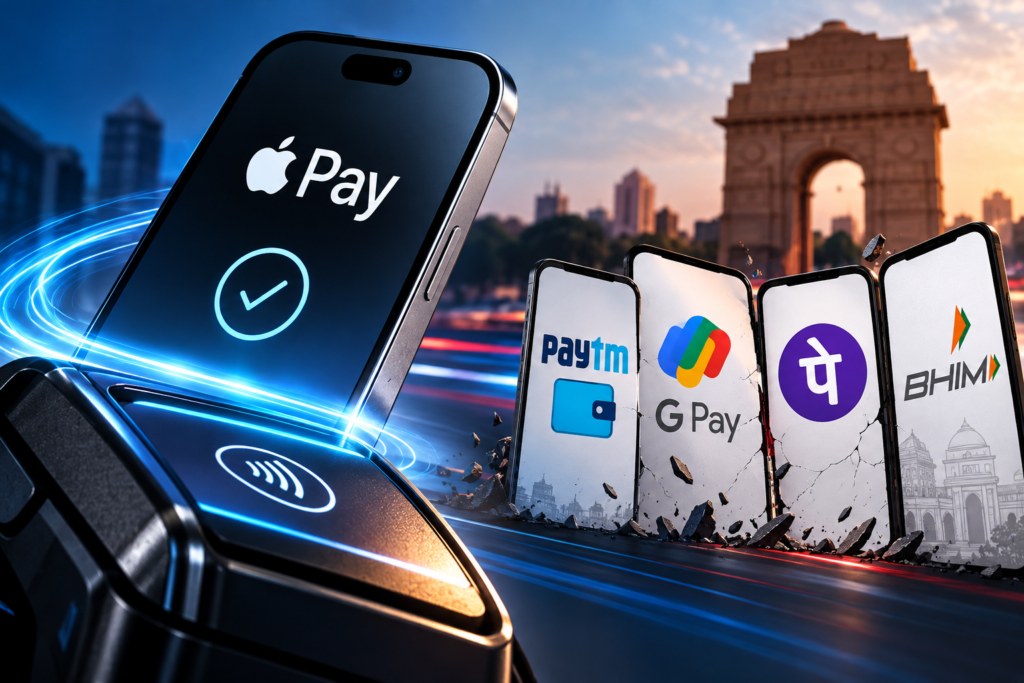
Apple’s potential expansion of Apple Pay in India could trigger a major shake-up in the country’s digital payments ecosystem. For years, PhonePe, Paytm and Google Pay have dominated consumer-facing digital payments, particularly through India’s Unified Payments Interface (UPI). But if Apple were to bring a fully integrated Apple Pay experience to iPhones in India, the competitive landscape could change dramatically.
The biggest threat would not necessarily come from Apple offering another payment application. It would come from Apple integrating payments directly into the iPhone experience.
Apple’s Biggest Advantage: The iPhone Ecosystem
Apple has something that most payment companies do not: complete control over its hardware, operating system and user experience.
An iPhone user already relies on Face ID, Apple Wallet, Apple Watch and other Apple services. If Apple Pay were deeply integrated with India’s UPI infrastructure, making a payment could potentially become as simple as double-clicking the side button, authenticating with Face ID and completing the transaction.
That kind of frictionless experience could challenge the established habits of millions of users.
Today, users generally open PhonePe, Google Pay or Paytm, select a payment option, scan a QR code or enter details and authenticate the transaction. Apple could attempt to make payments feel like a native iPhone function rather than a separate app.
PhonePe Could Face the Biggest Challenge
Among India’s major digital payment platforms, PhonePe could be particularly vulnerable to an Apple Pay push among premium smartphone users.
PhonePe has built a powerful network around UPI, merchant payments, bill payments, recharges, financial services and other offerings. However, its biggest strength is its scale rather than control over the device itself.
Apple could attack that advantage from the opposite direction.
Instead of convincing users to download and regularly use another payments app, Apple could put payments directly into the operating system.
For an iPhone owner, the question could eventually become: Why install another payment app if the phone already has a built-in payment system?
Paytm Could Face a Different Kind of Pressure
Paytm has built a broader financial ecosystem around payments, wallets, merchant services, financial products and its large merchant network.
Apple Pay’s arrival would not automatically eliminate these services. However, it could increase competition for the most valuable part of the market: everyday consumer transactions.
If Apple succeeds in making Apple Pay the default payment experience for iPhone users, Paytm could find itself competing not only against another fintech company, but against the entire Apple ecosystem.
That distinction is important.
Apple would potentially have the ability to use hardware integration, software design, security features and its enormous global ecosystem to create a differentiated payments experience.
What About Google Pay?
Interestingly, Apple Pay could also pose a threat to Google Pay in India.
Google Pay has become one of the most familiar UPI payment platforms in the country. But its position on iPhones is fundamentally different from its position on Android devices.
On Android, Google controls the operating system through Android and can integrate its services deeply into the platform.
On an iPhone, Apple controls the operating system.
If Apple Pay were permitted to offer a highly integrated UPI experience, Google Pay would have to compete for attention inside an ecosystem controlled by its biggest smartphone rival.
That could make Apple’s entry strategically significant for Google as well.
India’s UPI Could Be the Real Battleground
There is, however, an important distinction: Apple Pay entering India would not necessarily mean Apple replacing UPI apps overnight.
India’s digital payments market is heavily built around UPI. The success of any Apple payment service would therefore depend on how effectively Apple integrates with India’s existing payments infrastructure and regulatory framework.
If Apple Pay simply becomes another UPI application, its impact could be limited.
But if Apple can combine UPI with the advantages of Apple Wallet, Face ID, NFC, Apple Watch and iOS-level integration, the proposition becomes much more powerful.
The battle would then move from which payment app has the best features to which company controls the payment experience on the device.
Apple’s Premium User Base Could Be Its Secret Weapon
Apple’s market share in India’s overall smartphone market is far smaller than Android’s. Yet iPhone users represent an economically attractive segment.
Apple has a particularly strong presence among affluent consumers, professionals and urban users. These consumers are also attractive to banks, retailers, travel companies and premium brands.
If Apple Pay becomes widely adopted among this demographic, merchants would have an incentive to make the experience seamless.
That could create a network effect.
More iPhone users could mean more Apple Pay transactions. More transactions could encourage more merchants and financial institutions to optimise for Apple Pay. That, in turn, could make the service even more attractive to consumers.
But “Destroy” May Be Too Strong
Despite the potential threat, it would be premature to conclude that Apple Pay could simply destroy PhonePe, Paytm or Google Pay.
India’s payments market is enormous and highly competitive. UPI’s open ecosystem has allowed multiple apps to compete for users, while banks, fintech companies and technology platforms continue to innovate.
PhonePe and Google Pay also have enormous existing user bases and merchant networks. Paytm has extensive experience in merchant payments and financial services.
Apple would have to overcome another major challenge: India’s payment habits are different from those in markets where Apple Pay is already deeply established.
QR-code payments are extraordinarily popular in India, including among small merchants. A successful Apple payment strategy would therefore need to work seamlessly with the way Indians already pay.
The Bigger Threat Is Behavioural Change
The real disruption would occur if Apple changes consumer behaviour.
Imagine an iPhone user walking into a shop, scanning a UPI QR code, authenticating through Face ID and completing the transaction without opening PhonePe, Google Pay or Paytm.
At that point, Apple would not necessarily need to “beat” these companies feature-for-feature.
It would simply need to make the payment app itself less important.
That could be the most disruptive scenario.
Apple Pay’s potential expansion in India could become one of the most significant developments in the country’s digital payments industry.
PhonePe and Google Pay could face pressure over consumer engagement, while Paytm could face additional competition in merchant and consumer payments.
But Apple’s biggest weapon would not necessarily be its payment technology. It would be the iPhone itself.
If Apple successfully integrates UPI into the iPhone experience while maintaining Apple’s trademark emphasis on security, simplicity and ecosystem integration, India’s payments battle could enter a new phase.