


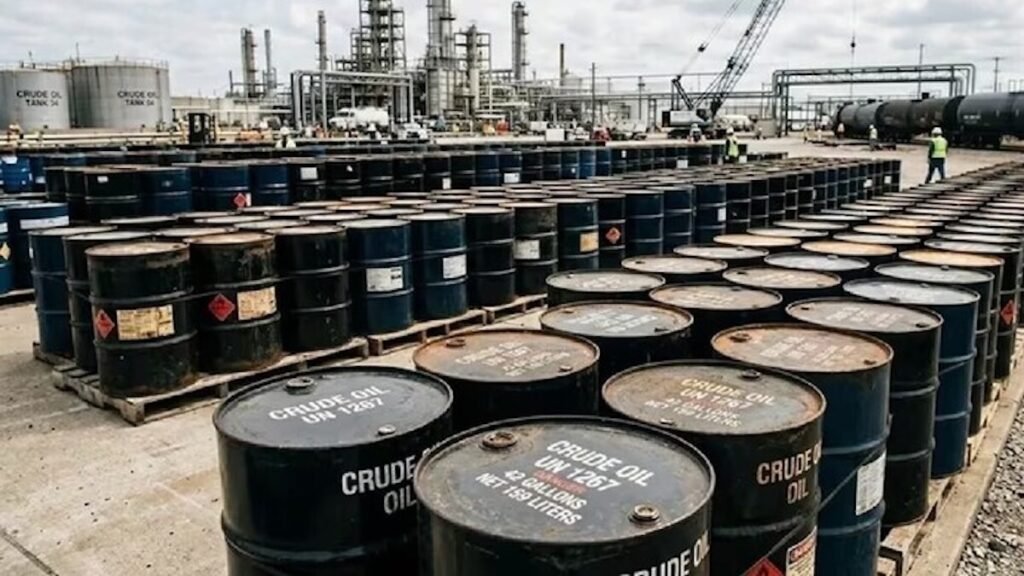
Brent Crude Oil Price: Brent crude oil prices remained near $104 per barrel on Friday as escalating attacks on oil tankers in the Strait of Hormuz and production disruptions caused by Hurricane Isaias in the Gulf of Mexico intensified concerns over global energy supplies.
Brent crude, the international benchmark, was trading 0.3% lower at $103.89 per barrel in the latest session after climbing 4% on Thursday to settle at $104.28. Meanwhile, US West Texas Intermediate (WTI) crude futures advanced 3.6% in the previous session to close at $91.49 per barrel.
The latest price movements reflect growing uncertainty in global oil markets, with geopolitical tensions in the Middle East coinciding with weather-related disruptions to US offshore oil production.
Strait of Hormuz Tensions Drive Oil Prices Higher
Escalating attacks on commercial vessels passing through the Strait of Hormuz have emerged as a major concern for oil traders. The strategic waterway connects the Persian Gulf with international shipping routes and is one of the world’s most important channels for crude oil transportation.
Nine tankers have reportedly come under attack in and around the Strait of Hormuz over the past week, raising fears that the recovery in oil shipments through the route could be interrupted.
Oil prices retreated from their session highs on Thursday after US President Donald Trump said Washington would not attack Iran before the November midterm elections. Earlier reports had suggested that Trump and his national security team were considering renewed military strikes in the coming weeks.
Despite the temporary easing in prices, uncertainty over regional security continues to influence trading sentiment.
Oil Shipments Through Hormuz Remain Below Normal
Crude oil flows through the Strait of Hormuz remain significantly below levels recorded before the Iran war.
Data from Kpler indicated that approximately 9.5 million barrels per day passed through the waterway during the week ended Tuesday, around 30% below normal pre-war levels.
However, total crude oil flows from the Middle East, including alternative pipeline routes, reached approximately 16.4 million barrels per day, bringing overall regional shipments close to pre-war levels.
Further attacks on tankers could undermine the recovery in transportation volumes, potentially tightening global supplies and putting additional upward pressure on benchmark crude prices.
Hurricane Isaias Disrupts Gulf of Mexico Production
Weather-related disruptions have added another layer of uncertainty to the oil market. Hurricane Isaias has forced energy companies to suspend a portion of offshore production in the Gulf of Mexico as the storm approaches the US Gulf Coast.
Approximately 500,000 barrels per day of production has been shut in, representing around 25% of offshore oil output in the region.
The shutdown threatens to reduce US domestic supplies at a time when international markets are already facing concerns over crude transportation through the Middle East.
The duration of the production outages and the extent of infrastructure damage, if any, will be important factors in determining the impact on oil prices.
Middle East Escalation Adds to Supply Concerns
Regional tensions have intensified following missile attacks by Iran-backed Houthi militants in Yemen targeting areas around Riyadh and Abha in Saudi Arabia. Saudi state-owned media reported three fatalities and 36 injuries.
Saudi Arabia’s military subsequently said it intercepted another volley of ballistic missiles directed towards Riyadh and Khamis Mushait.
The developments have heightened concerns about the security of regional energy infrastructure and transportation routes, adding to uncertainty across international oil markets.
Brent Crude Price Outlook
Brent crude prices are likely to remain sensitive to developments involving the Strait of Hormuz, the resumption of suspended Gulf of Mexico production and further geopolitical escalation.
A prolonged disruption to tanker movements or offshore output could tighten supplies and sustain upward pressure on prices. Conversely, an improvement in shipping conditions, a reduction in regional tensions or a swift recovery in US production could ease some of the pressure.
For investors, energy companies and oil-importing economies, the immediate outlook will depend on whether the latest disruptions remain temporary or develop into a more sustained challenge to global crude oil supplies.