



Aachho, a Jaipur-based fashion startup, has built a visible online presence around ethnic wear, festive collections and aspirational design. But a growing body of customer complaints online raises an uncomfortable question: are buyers paying premium prices while receiving products, service and post-purchase support that do not meet the same standard?
This is not a verdict on every product or every customer experience. Aachho also displays a large number of positive reviews on its own platform, and some independent reviewers say they liked the designs or received items matching their expectations. However, complaints visible on public review platforms and social-media posts point to recurring concerns over product quality, sizing, delivery, customer support, exchanges and the absence of cash refunds after delivery. These are issues that any consumer-facing brand, especially one positioning itself as premium, must address transparently.
The gap between promise and delivery
Fashion brands do not sell fabric alone. They sell trust: the promise that an outfit will resemble its photographs, feel appropriate for its price, arrive on time and be backed by a reasonable solution if something goes wrong.
Several customers reviewing Aachho on third-party platforms have alleged that the products they received did not justify the price paid. Their complaints include fabric quality they considered below expectations, poor finishing, fit and sizing discrepancies, and products that they felt looked different from the advertised images. Such accounts are customer allegations, not independently verified findings, but their repetition across review forums makes them difficult to dismiss as isolated dissatisfaction.
The concern becomes sharper because the brand’s positioning is built around premium-looking ethnic fashion. A customer buying an occasion-wear suit set, saree or festive garment does not merely compare it with the cheapest option in the market. They compare it with the expectation created by product photography, promotional language and price. If the delivered piece feels cheaper, less refined or materially different from what was anticipated, the disappointment is not only about the garment—it is about whether the consumer was given a fair representation before purchase.
For a digital-first fashion business, this distinction is crucial. Consumers cannot touch the fabric, examine stitching or assess colour accuracy before paying. Product pages, images, descriptions and customer service therefore carry a higher responsibility. A premium price must come with premium clarity.
Negative reviews raise red flags
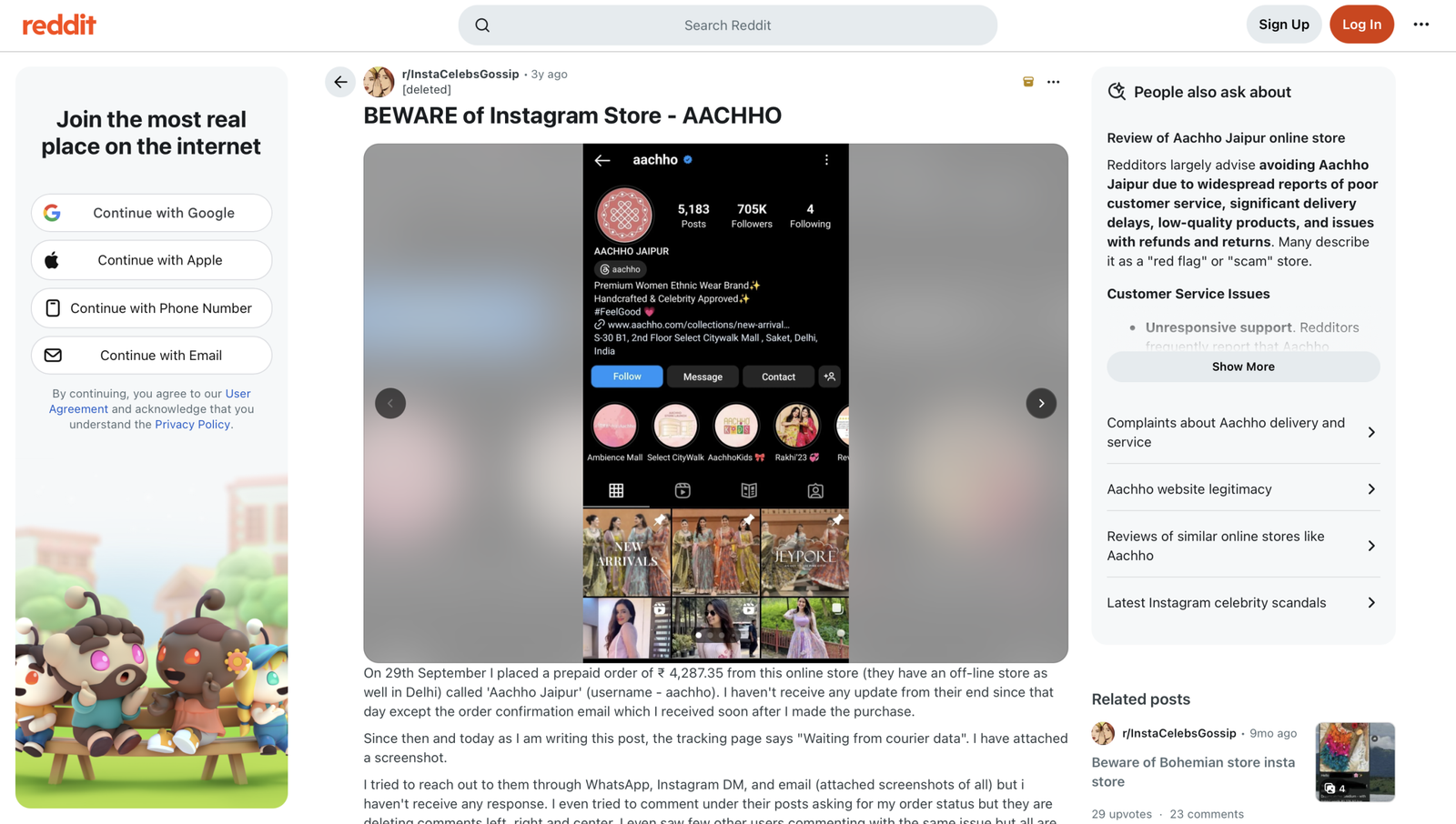

Aachho has received notably poor feedback on Trustpilot, where its profile has been listed with a score around 1.8–1.9 out of 5 in indexed results, based on more than 1,500 reviews at different points. Reviewers have repeatedly mentioned concerns around delivery delays, perceived quality issues, sizing problems and difficulty reaching customer support.
Individual public complaints should always be treated carefully. Online reviews can be subjective, incomplete and shaped by a particularly bad experience. Yet when multiple customers independently raise similar themes, they reveal a pattern worth examining.
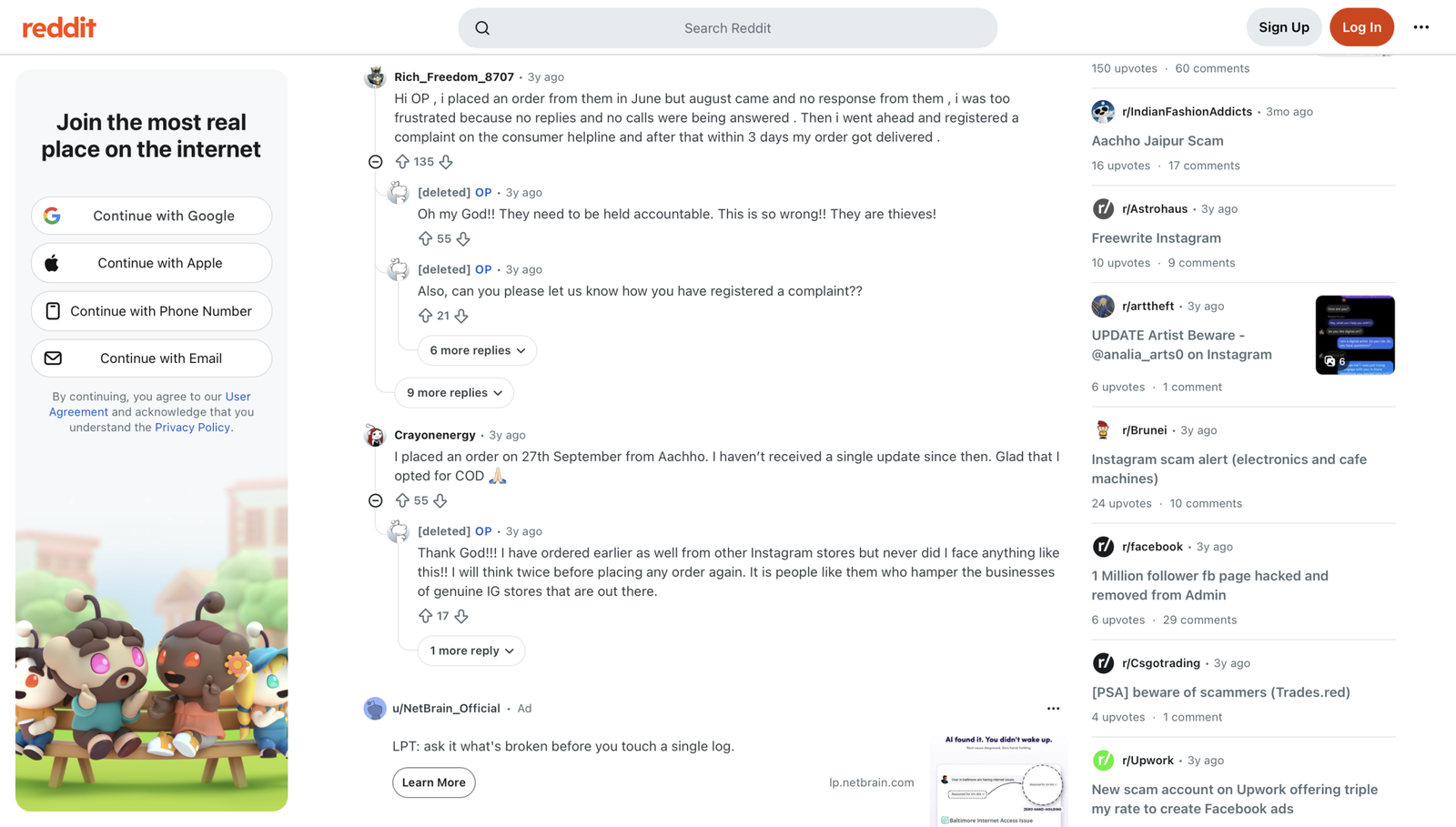

Among the allegations visible in public posts and reviews are:
-
Products allegedly arriving in poor condition or with defects.
-
Customers saying the received item, colour, material or size did not meet expectations.
-
Complaints about delayed dispatch, delayed delivery or inadequate tracking updates.
-
Frustration over calls and emails allegedly going unanswered.
-
Claims that customers had to pursue support repeatedly for an exchange, credit note or resolution.
-
Objections to an exchange-related charge of ₹300 per product.
-
Claims that customers were asked to provide unboxing videos or other evidence after a complaint arose.
These are serious allegations because fashion purchases are often time-sensitive. A garment ordered for a wedding, festival, family event or special occasion loses much of its value if it reaches late, does not fit, or cannot be returned when it differs from the customer’s expectation.
No refund policy: a difficult proposition
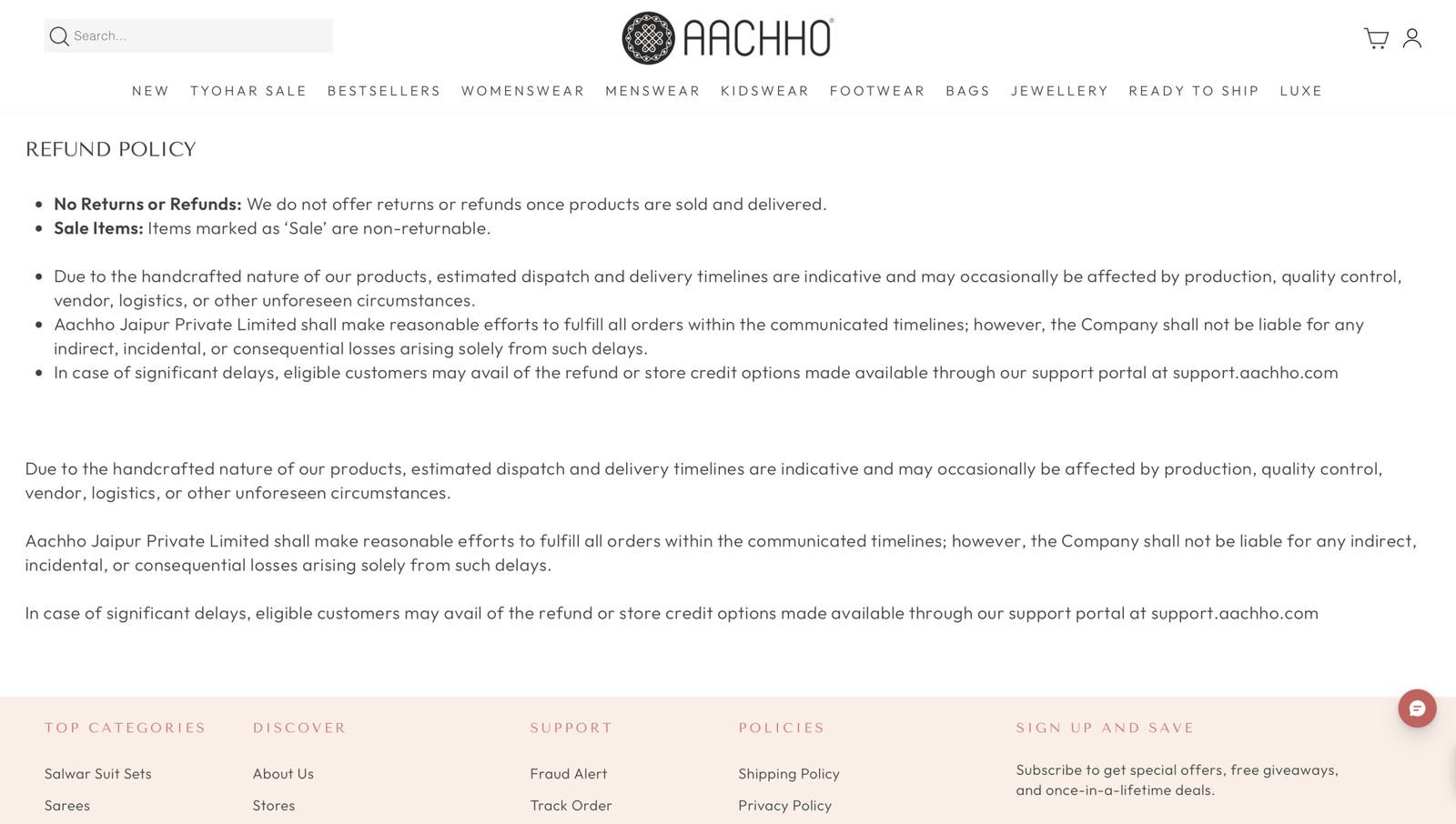
Aachho’s published refund policy states that it does not offer returns or refunds once products have been sold and delivered. The policy instead outlines exchanges for eligible domestic orders, subject to conditions such as the product being unused, unwashed and unworn, with original packaging and tags intact. It also states that an exchange request should be raised within 24–48 hours of delivery, and lists a ₹300 processing fee per product for the exchange process.
The company’s shipping policy also says sale items are final and non-returnable, while a product page asks customers to record an unboxing video and take time-stamped photographs within 48 hours in case of a damaged or opened parcel.
A strict no-return or no-refund policy is not automatically unlawful merely because it is unpopular; terms can vary by business and product category. But the real test is whether the policy is fair, prominently disclosed and workable when a buyer receives a defective, wrong, damaged or materially misrepresented product.
That is where consumer frustration becomes understandable. If a customer believes a garment is poor quality, incorrectly sized, different from the listing, or defective, an exchange-only route can feel inadequate—particularly when the buyer is also asked to pay an additional ₹300 processing fee. A credit note may help a customer who wants to purchase again, but it does not satisfy someone who has lost confidence in the brand.
A no-refund policy may protect a retailer from casual returns, but it should not become a shield against accountability. Premium commerce cannot operate on the assumption that every complaint is buyer’s remorse.
Transparency is the real premium
The problem is not that a brand has a policy. Every retailer needs one. The question is whether the policy matches the promise made to customers.
If Aachho charges premium or near-premium rates, it should ensure that its product listings provide clearer fabric information, accurate colour representation, reliable size charts, close-up images of embroidery and stitching, and realistic delivery commitments. It should also make refund, exchange and evidence requirements impossible to miss before checkout—not bury them in policy pages that many buyers discover only after a dispute.
The brand could also improve confidence by clearly separating cases:
-
Change-of-mind requests, where exchange-only rules may be reasonable.
-
Size-related concerns, where a free first exchange could be considered.
-
Wrong, damaged or defective products, where customers should not bear exchange charges.
-
Material mismatch or misleading listing claims, where a refund mechanism should be available after verification.
This kind of distinction is not merely good public relations. It is fundamental to fair online retail.
Time for consumer-first accountability
The rise of Jaipur-based digital fashion startups has created opportunity, design visibility and access to regional craftsmanship. But growth also brings responsibility. Startups cannot rely only on attractive campaigns, influencer visibility or festive discounts. Their long-term credibility depends on what happens after payment—when the parcel arrives and the customer needs help.
Aachho should publicly address the concerns being raised, respond to customers who allege unresolved issues, and explain how it verifies quality before dispatch. It should also reconsider whether charging customers for exchanges is appropriate in disputes involving alleged defects, incorrect deliveries or product-quality concerns.
Consumers, meanwhile, should read policies before ordering, retain invoices, photograph parcels at delivery, record an unboxing video where a seller expressly asks for one, and save all written communication. These are practical safeguards in an online shopping environment where resolving a dispute can be harder than placing an order.
The larger issue is simple: a premium price should buy more than a visually appealing product page. It should buy quality, honesty, accessible support and a fair remedy when expectations are not met. Until brands such as Aachho close that gap, the negative reviews will continue to raise a valid question—are customers paying for premium fashion, or paying the price for weak accountability?