


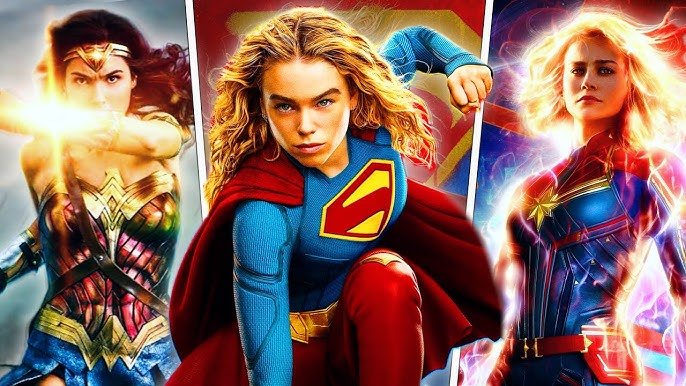
For more than a decade, Hollywood has promised a new era of female-led superhero films. From Captain Marvel and Wonder Woman to Madame Web and the recently released Supergirl, studios have invested heavily in putting women at the center of blockbuster franchises. Yet, despite the ambition, very few standalone female superhero movies have managed to achieve both critical acclaim and long-term commercial success.
The mixed response to Supergirl, which arrived after the renewed excitement surrounding last year’s Superman reboot, has once again sparked the debate over why these films continue to struggle. The answer, however, may have less to do with audiences rejecting female heroes and more to do with how Hollywood chooses to tell their stories.
The Weight of Representation
One of the biggest challenges facing female-led superhero films is the enormous expectation placed upon them before they even reach cinemas. Rather than being marketed simply as entertaining comic-book adventures, these films are often presented as milestone moments for representation. While representation is undoubtedly important, it can sometimes overshadow the most essential ingredient of any successful movie a compelling story.
When Iron Man launched the Marvel Cinematic Universe in 2008, Tony Stark wasn’t expected to represent every male superhero. He was allowed to be arrogant, funny, selfish, vulnerable, and deeply flawed. His personality drove the film. Many female superheroes, by contrast, arrive carrying the burden of symbolizing progress. Instead of simply existing as memorable characters, they are often expected to represent an entire movement, creating expectations that no single film can realistically satisfy.
Formula Fatigue Is the Bigger Villain
Another obstacle is superhero fatigue itself. After nearly two decades of interconnected cinematic universes, audiences have become increasingly selective. They no longer show up simply because a character wears a cape.
Recent successes such as The Batman and Guardians of the Galaxy Vol. 3 stood apart because they offered distinctive storytelling styles and emotional depth. They felt unique rather than manufactured. Many female-led superhero films, however, have relied too heavily on familiar origin stories, predictable action beats, and franchise-building formulas. The issue isn’t that the lead character is a woman it’s that the films often struggle to establish an identity beyond their place in a larger cinematic universe.
Even acclaimed filmmakers have found it difficult to break this pattern. Directors like Chloé Zhao and Patty Jenkins, along with major studio architects such as James Gunn and Kevin Feige, have all experienced varying levels of success with female-centric superhero projects. Their mixed results suggest that the problem lies within the industry’s approach rather than any individual filmmaker.
Audiences Want Better Stories, Not Different Genders
Evidence also suggests that viewers are more than willing to embrace female superheroes when the storytelling is strong. Characters like Spider-Woman in the Spider-Verse films, Wanda Maximoff in WandaVision, Agatha Harkness in Agatha All Along, and the television version of Supergirl all earned loyal fan bases because they were given time to grow into layered, emotionally complex characters. Television, in particular, has allowed female superheroes to evolve naturally instead of compressing their journeys into a single two-hour blockbuster.
The lesson is simple: audiences respond to well-written characters regardless of gender.
Bollywood Has Already Shown the Formula
Indian cinema provides another interesting comparison. Films like Mardaani, Raazi, and Gangubai Kathiawadi have demonstrated that audiences enthusiastically support female-led stories when the characters feel authentic and emotionally grounded. These films prioritized compelling narratives over spectacle, allowing their protagonists to succeed because of strong writing rather than symbolic importance.
The same principle may influence audience expectations for upcoming projects like YRF’s Alpha, starring Alia Bhatt and Sharvari Wagh, where viewers will likely judge the film on storytelling before representation.
The Real Superpower Is Humanity
Perhaps Hollywood’s biggest challenge isn’t creating stronger female superheroes it is creating more human ones. The most beloved comic-book characters aren’t remembered simply because they save the world. Superman, Spider-Man, and Batman continue to resonate because they make mistakes, struggle with personal conflicts, and remain relatable beneath their extraordinary abilities.
Female superheroes deserve the same creative freedom.
Instead of trying to create perfect role models or cinematic milestones, Hollywood may find greater success by focusing on flawed, funny, vulnerable, and deeply human protagonists. When audiences connect with the person behind the costume, the superhero naturally follows.