




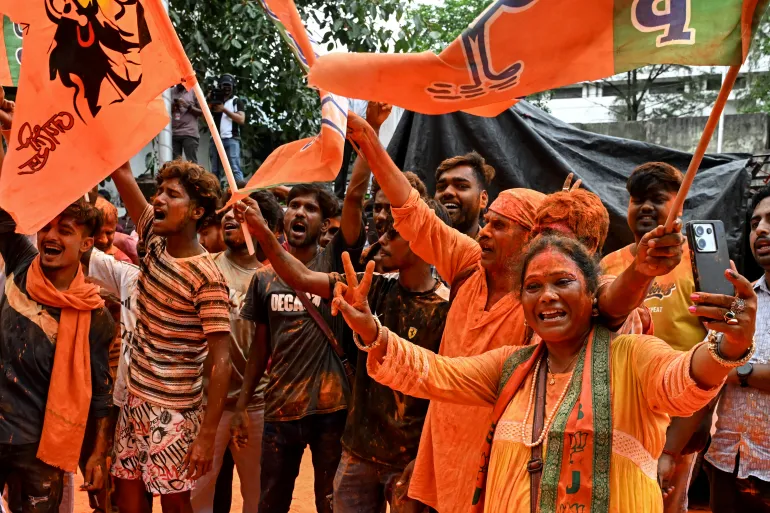


The Bharatiya Janata Party’s aggressive push to capture West Bengal was not just another electoral campaign—it was a calculated political invasion that exposed the party’s growing disregard for democratic norms and federal balance.
What unfolded in Bengal was not healthy political competition. It was an all-out power grab. The BJP deployed its entire central machinery—top ministers, massive financial resources, relentless propaganda—to overwhelm a state election and convert it into a referendum on its national dominance. Bengal was not treated as a state with its own political identity; it was treated as territory to be conquered.
This raises an uncomfortable but necessary question: when does electoral ambition cross the line into political overreach?
The BJP’s campaign in Bengal was built less on governance and more on division. Instead of presenting a coherent developmental roadmap for the state, the narrative was saturated with polarization, identity politics, and manufactured outrage. The aim was clear—to fracture Bengal’s social fabric for electoral gain. Such tactics may yield short-term political mileage, but they come at a long-term cost to social cohesion.
Even more troubling was the systematic use of central power structures in a manner that appeared deeply political. Investigative agencies suddenly became hyperactive in opposition-ruled states, including West Bengal. Whether or not each case had merit, the selective intensity created a perception that institutions were being weaponized. In a democracy, perception matters as much as legality—and in this case, the perception was deeply damaging.
Then came the parade of defections. Leaders who were yesterday branded corrupt or incompetent were suddenly welcomed into the BJP fold with open arms. This blatant opportunism stripped the party of any moral high ground it claimed. It revealed a simple truth: ideology was secondary; power was everything.
Perhaps the most alarming aspect of the BJP’s Bengal strategy was its disregard for federal principles. The constant confrontation with the state government, the attempt to dominate narratives from Delhi, and the unwillingness to engage constructively signaled a dangerous centralizing instinct. India’s strength lies in its federal diversity—not in the domination of states by a single political force.
The people of Bengal saw through this. The electoral verdict was not just a rejection of a party—it was a rejection of an approach rooted in arrogance and overreach. It was a reminder that India’s democracy, despite its flaws, still has the capacity to resist concentrated power.
But the lesson does not end with Bengal. If the BJP continues down this path—where elections are treated as wars, opponents as enemies, and institutions as tools—the consequences will extend far beyond one state.
Democracy is not just about winning. It is about how you choose to win. And in Bengal, the BJP chose a path that should concern anyone who believes in the spirit of India’s democratic framework.