




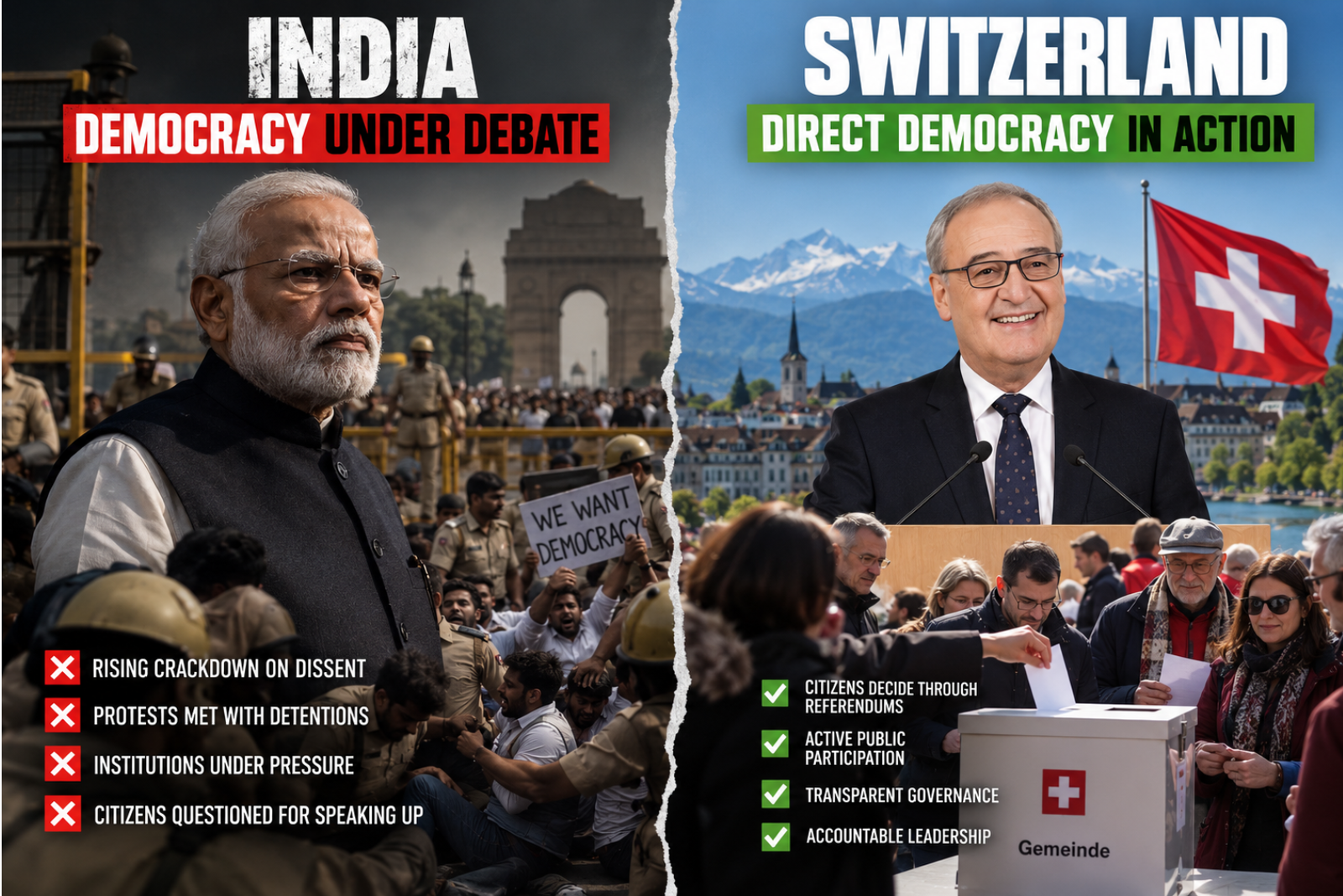


India is the world’s largest democracy, built on the principles of freedom, equality and the right of citizens to question those in power. However, growing concerns over restrictions on protests, the treatment of political opposition and the role of democratic institutions have raised questions about the state of democracy under Prime Minister Narendra Modi and the Bharatiya Janata Party (BJP).
Critics argue that the concentration of political power and the suppression of dissent risk weakening democratic accountability. They contend that when citizens face obstacles while questioning government decisions, democracy can gradually become more focused on political authority than public participation.
The central question is whether India’s democratic institutions are providing sufficient space for citizens to challenge those in power or whether the growing political confrontation is making peaceful dissent increasingly difficult.
Democracy Cannot Exist Without the Right to Question the Government
A democratic government must remain accountable to the people who elect it. Citizens do not surrender their rights after voting, nor does an electoral victory give a political party unlimited authority over public opinion.
Freedom of speech, peaceful assembly and the ability to criticise government policies are essential features of a functioning democracy. These rights allow citizens to raise concerns, demand transparency and seek explanations from elected representatives.
Critics of the Modi government argue that the handling of protests and political opposition has created an atmosphere in which dissent can be treated as a challenge to authority rather than an essential part of democratic debate.
The government, however, has responsibilities to maintain public order and enforce the law. The key issue is whether restrictions on demonstrations are lawful, necessary and proportionate, and whether citizens have meaningful avenues to challenge decisions they believe infringe their rights.
A democracy becomes vulnerable when people begin to fear that expressing disagreement could bring disproportionate consequences.
BJP’s Political Dominance Raises Questions About Accountability
The BJP’s political dominance under Narendra Modi has intensified debates about the concentration of power and the functioning of institutions responsible for holding the government accountable.
Critics contend that excessive personalisation of political leadership can weaken public scrutiny by encouraging political debate to revolve around loyalty to a leader rather than the merits of government decisions.
In a healthy democracy, no political leader should be beyond criticism. Governments must answer questions about their policies, spending, administration and treatment of citizens, regardless of their electoral popularity.
The concern is not simply about Modi or the BJP. It is about the precedent that concentrated political power could establish for future governments.
India belongs to its citizens, not to a political party or an individual leader. Elections provide governments with a mandate to govern, but that mandate remains subject to constitutional limits, public scrutiny and the rule of law.
Protests Are a Democratic Right, Not a Favour From Those in Power
Peaceful protests have historically played an important role in India’s political development. They allow citizens to express dissatisfaction, bring overlooked issues into public debate and demand action from authorities.
When demonstrations face restrictions or protesters are detained, the circumstances require scrutiny. Authorities may need to regulate public gatherings for legitimate security and public-order reasons, but those powers should not become a blanket justification for preventing peaceful dissent.
Critics of the BJP government argue that the treatment of protesters and opposition leaders deserves closer examination, particularly when demonstrations concern public institutions or electoral processes.
The same standards should apply to every political party. Supporters of the ruling government and its critics must enjoy equal protection under the law.
A government that is confident in its democratic mandate should be able to respond to criticism through explanations, evidence and lawful processes rather than allowing political disagreement to become a confrontation between citizens and the state.
Switzerland Demonstrates How Citizens Can Directly Influence National Decisions
Switzerland offers an important example of a political system in which citizens have regular opportunities to participate directly in national decision-making.
Unlike India’s primarily representative parliamentary democracy, Switzerland combines elected representatives with mechanisms such as popular initiatives and referendums. These allow citizens to influence constitutional changes and, under specified conditions, challenge legislation through public votes.
The Swiss model demonstrates that public participation does not have to end with elections. Citizens can also have a direct role in shaping particular policy decisions.
India’s population, federal structure and social diversity differ significantly from Switzerland’s, so adopting the Swiss system wholesale would involve considerable practical and constitutional questions. Nevertheless, the underlying principle deserves attention: citizens should have meaningful opportunities to question decisions and influence the direction of their country.
India could explore stronger public consultations, more transparent decision-making, effective parliamentary scrutiny and greater participation in local governance to strengthen public accountability.
Independent Institutions Are Essential to Protect Democracy
Democracy depends on institutions that can operate independently and apply the law fairly. Parliament, the judiciary, election authorities and other oversight bodies play important roles in ensuring that political power remains subject to constitutional limits.
Concerns about institutional independence should be examined through documented decisions, legal proceedings, transparency and the actual functioning of oversight mechanisms.
When citizens question electoral procedures, government policies or administrative decisions, their concerns should be addressed through transparent processes that allow evidence to be examined.
Similarly, political opposition should be able to perform its constitutional role without being treated as illegitimate simply because it challenges the ruling party.
Protecting institutional independence is not a demand for one political party to lose power. It is a safeguard for every citizen, including those who may support a different government in the future.
National Loyalty Must Not Be Confused With Loyalty to a Political Leader
One of the dangers of polarised politics is the tendency to portray criticism of a government as criticism of the country itself.
A government and a nation are not the same. Political leaders hold office temporarily, while the country and its constitutional institutions continue beyond individual administrations.
Citizens must be free to question government decisions without having their patriotism judged solely by their political views. Journalists, students, activists and opposition leaders all have legitimate roles in democratic debate, subject to the law.
The right to criticise a government should not depend on whether the ruling party agrees with the criticism.
This principle must apply equally to the BJP, the Congress and every other political organisation. Democracy is strongest when political competition takes place within a shared commitment to constitutional rights and the rule of law.
Can India Strengthen Democracy Through Greater Citizen Participation?
India already has constitutional protections for freedom of expression, peaceful assembly and judicial review. The challenge is ensuring that these protections remain effective in practice.
Several measures could strengthen democratic accountability:
- Greater parliamentary scrutiny: Important legislation should receive meaningful debate and examination.
- Transparent government decisions: Public policies and administrative actions should be supported by clear explanations wherever disclosure is legally permissible.
- Protection for peaceful protests: Restrictions should be lawful, proportionate and open to appropriate review.
- Institutional independence: Constitutional bodies should be able to perform their duties without improper political interference.
- Meaningful citizen participation: Public consultations and local decision-making mechanisms should give people greater opportunities to influence policies affecting their lives.
These measures would not weaken an elected government. They would strengthen public confidence by ensuring that political authority remains accountable.
Conclusion: Democracy Must Remain Above Any Individual Leader
India’s democratic future should not depend on the popularity of Narendra Modi, the electoral success of the BJP or the ambitions of any individual political leader.
The concerns raised by critics about dissent, institutional accountability and political power deserve serious examination. At the same time, describing India as a dictatorship would require a broader assessment of its elections, institutions, constitutional safeguards and actual restrictions on political freedoms.
The essential question is whether citizens can freely criticise the government, peacefully demonstrate, challenge official decisions and hold public authorities accountable without facing unjustified restrictions.
Switzerland demonstrates one way of giving citizens a direct role in public decisions, while India’s own constitutional framework provides the foundation for protecting democratic rights.
A government may win an election, but it does not own the nation. Democracy means that citizens have the right to choose their leaders and the continuing right to question them.