




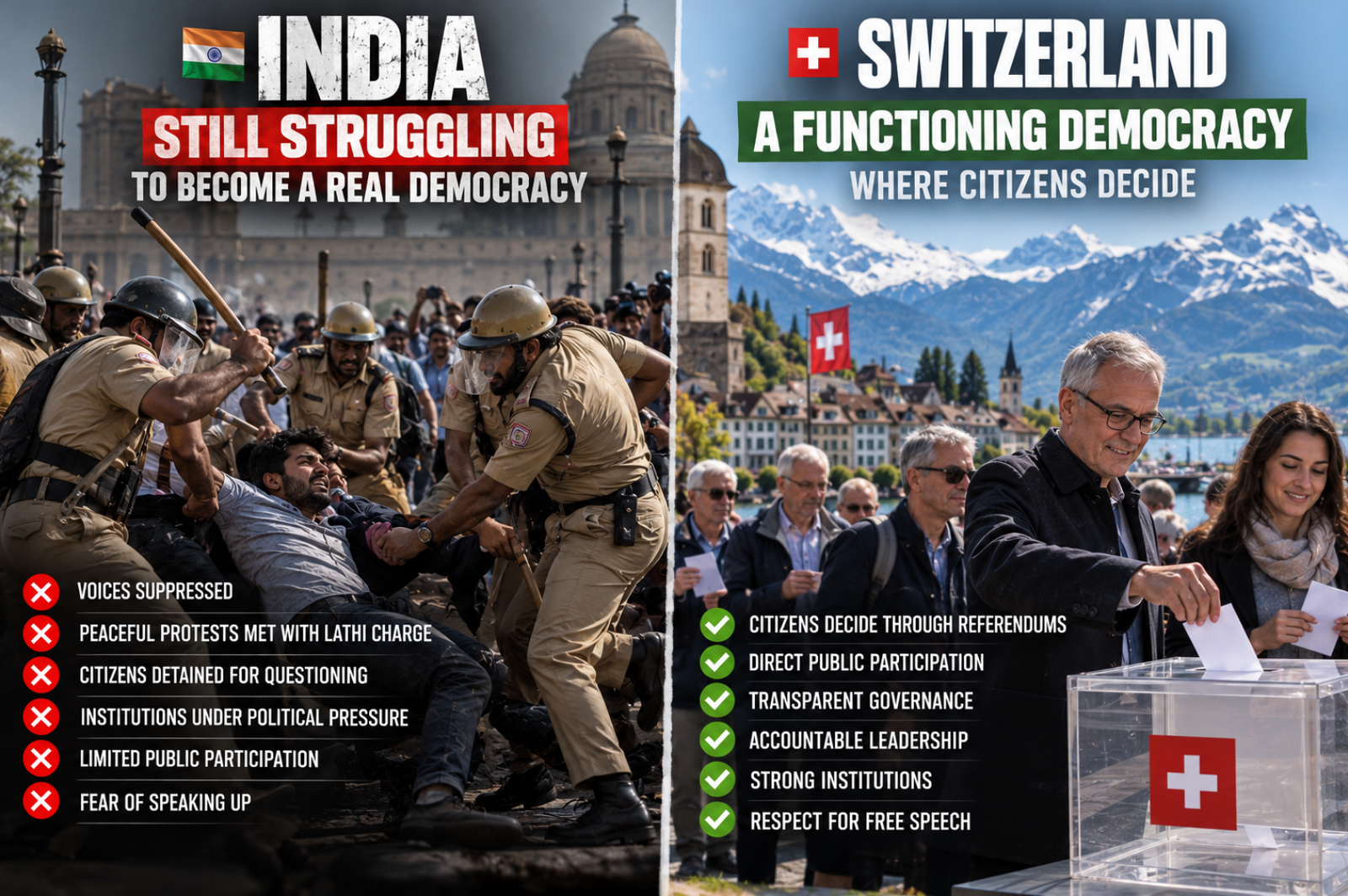


India is the world’s largest democracy, but a fundamental question continues to arise: Is conducting elections enough to make a country truly democratic, or does democracy also require freedom of speech, the right to protest and accountability for those in power?
While India has a democratic Constitution, a multiparty political system and regular elections, Switzerland has developed a system that allows citizens to participate directly in certain political decisions through popular initiatives and referendums. The comparison raises important questions about how democratic principles are implemented in everyday governance.
Concerns over police action against protesters, restrictions on public gatherings and the treatment of government critics have intensified the debate over India’s democratic health. If citizens cannot freely question those in power or fear violence when they raise their voices, the promise of democracy risks becoming weaker.
Democracy Is More Than Just Elections
India has established important democratic institutions since independence. Citizens elect their representatives, political parties compete for power, courts can review government actions, and voters have the ability to change governments through elections.
However, democracy does not end when the votes are counted. It also depends on whether citizens can criticise the government, whether journalists can report independently, and whether peaceful protesters can express their demands without facing disproportionate force.
When people feel that their voices are ignored or that questioning the government could invite punishment, democratic participation becomes more difficult. Elections may continue, but the public’s ability to hold elected representatives accountable between elections becomes equally important.
A government’s commitment to democracy is tested most seriously when citizens disagree with it.
When Peaceful Protesters Face Police Action
Peaceful protests are a recognised feature of democratic societies. People organise demonstrations to raise concerns about employment, public policy, corruption, civil liberties and decisions they believe are unjust.
Police have a legitimate responsibility to maintain public order and protect public safety. However, that responsibility does not give law enforcement unlimited authority to use force against demonstrators.
When police beat people with batons, detain peaceful protesters or use excessive force, the circumstances demand scrutiny. Authorities must establish whether the action was lawful, necessary and proportionate. Allegations of misconduct should be investigated transparently, and proven wrongdoing must have consequences.
The same standards should apply regardless of the political party in power or the ideology of those participating in a demonstration.
A democracy cannot be judged only by how it treats supporters of the government. It must also be judged by how it treats citizens who oppose government policies.
Switzerland Shows How Citizens Can Participate Beyond Elections
Switzerland provides a different model of democratic participation. Its political system combines elected representatives with mechanisms that allow citizens to influence specific decisions directly.
Through popular initiatives, citizens can seek constitutional amendments if the required conditions are met. Through optional referendums, eligible citizens can challenge certain laws and trigger a public vote. These mechanisms give citizens formal opportunities to influence political decisions between elections.
This does not mean that Switzerland is free from political disagreements or governance challenges. Nor does every decision require a nationwide public vote. Its system operates through established constitutional rules and democratic procedures.
Nevertheless, Switzerland demonstrates how citizens can be given institutional tools to challenge decisions rather than relying exclusively on elected representatives to respond to their demands.
India could learn from this approach by strengthening public consultation, protecting peaceful demonstrations and creating more meaningful opportunities for citizens to influence decisions that affect their lives.
Can India Take Another 200 to 400 Years to Become a Fully Functioning Democracy?
If concerns about the suppression of dissent, excessive police force and inadequate accountability remain unresolved for generations, India could struggle for a long time to realise the full promise of its democratic Constitution.
A country may continue holding elections while public participation becomes increasingly restricted in practice. If citizens lose confidence that their voices matter, democratic institutions can remain formally intact while public trust in them deteriorates.
Could India take another 200 or 400 years to achieve a stronger democratic culture if current problems continue? Such a timeframe cannot be established as a factual prediction. Political systems do not follow a fixed timetable, and no credible evidence can determine that India would need centuries to improve its democratic standards.
However, the underlying warning is serious: if the suppression of peaceful dissent becomes normalised and accountability continues to weaken, India’s democratic progress could remain incomplete for generations.
The alternative is equally important. Stronger safeguards for civil liberties, independent investigations into police misconduct, judicial accountability and meaningful citizen participation could produce improvements much sooner.
India’s future is not predetermined. The direction it takes will depend on the decisions made by governments, institutions and citizens.
Why Police Accountability Matters for Democracy
The police are essential to public safety, but their authority must remain subject to the law. The use of batons or other force against demonstrators should never be treated as automatically justified simply because a protest creates a challenge for the administration.
Questions must be asked whenever excessive force is alleged. Were protesters violent or peaceful? Was the force necessary? Were less harmful measures available? Did the authorities investigate complaints independently?
Transparent procedures, effective complaint mechanisms and consequences for proven misconduct can help protect citizens and improve public confidence in law enforcement.
Without accountability, people may become reluctant to exercise their rights. With accountability, police can maintain public order while respecting the freedoms that democratic societies are expected to protect.
India Must Protect Dissent to Strengthen Democracy
India does not need to abandon its existing democratic framework. It needs to ensure that its democratic principles are applied consistently.
Peaceful protest should not be treated as a threat merely because it criticises the ruling party. Independent journalism should be protected, allegations of official misconduct should be investigated, and courts should remain capable of scrutinising government action.
Political parties must also respect democratic principles when they hold power. The right to protest cannot depend on whether a demonstration supports or opposes the government.
Switzerland’s system cannot simply be copied into India because the two countries differ considerably in population, political structure and administrative complexity. However, India can explore stronger public consultation, more transparent governance and additional opportunities for citizens to participate in policymaking.
The objective should be to ensure that citizens have meaningful ways to question decisions, seek accountability and influence the direction of their country.
Conclusion: Democracy Cannot Flourish Where Citizens Are Afraid to Speak
India has a democratic Constitution, competitive elections and institutions that provide important protections for citizens. Switzerland offers an example of how direct-democratic mechanisms can complement representative government and give people additional opportunities to influence political decisions.
The central question is whether democratic rights are protected consistently in everyday life. When peaceful protesters fear excessive police action, when citizens believe their complaints will go unheard, or when accountability mechanisms fail to function effectively, the democratic promise is weakened.
If these concerns remain unresolved, India could struggle for decades or even generations to build a political culture in which every citizen feels empowered to question authority. But there is no fixed 200- or 400-year deadline for democratic progress. Reform can begin whenever institutions and political leaders demonstrate a genuine commitment to accountability and civil liberties.
Democracy is not merely the right to choose a government. It is also the right to question that government, peacefully oppose its decisions and demand answers without fear.