



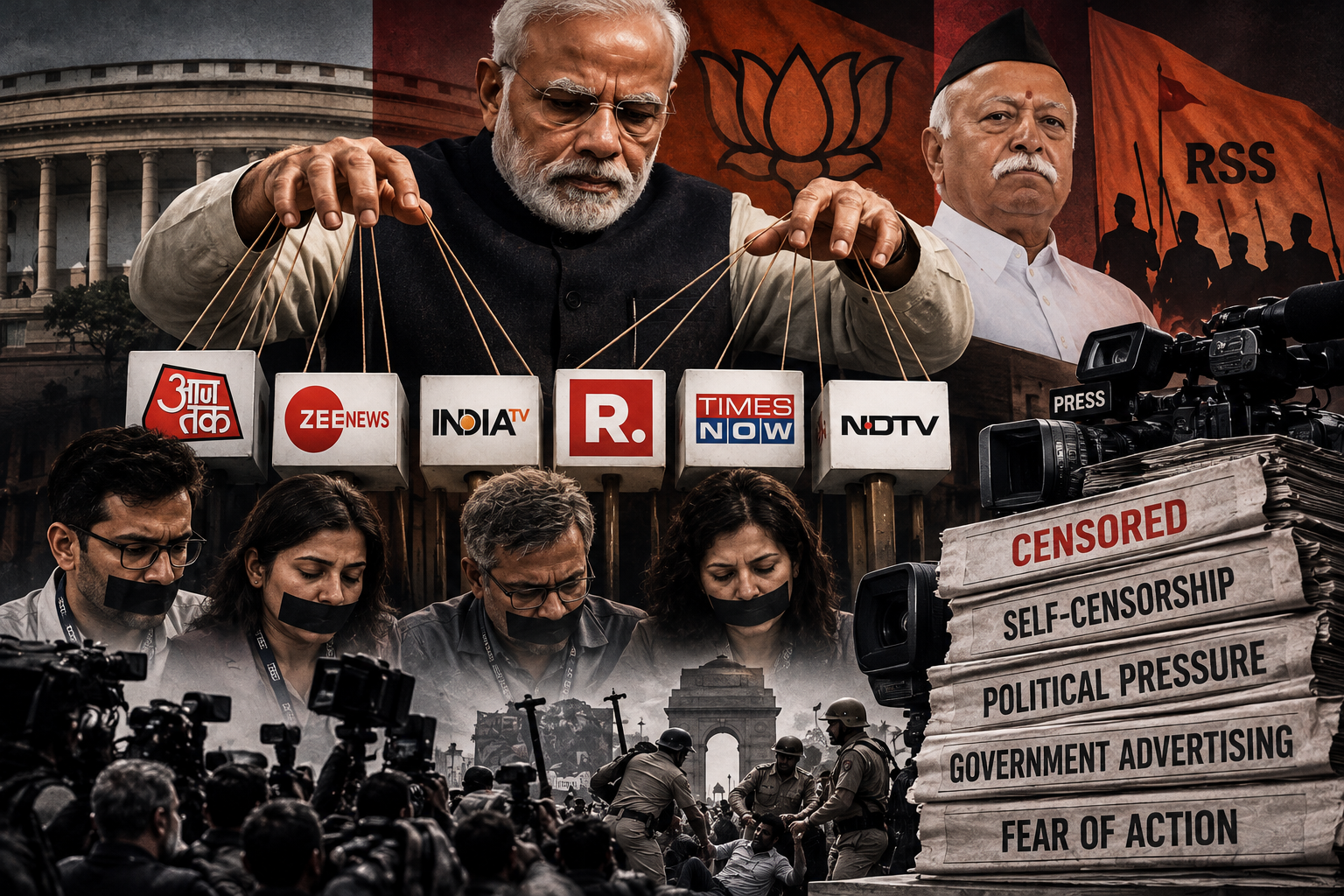


Since Narendra Modi and the Bharatiya Janata Party (BJP) came to power in 2014, India’s media landscape has undergone significant changes. The expansion of corporate ownership, increasing political polarisation, pressure on journalists and the growing influence of government advertising have raised questions about the independence of the country’s news media.
The Rashtriya Swayamsevak Sangh (RSS), a Hindu nationalist organisation ideologically associated with the BJP, has also played an important role in shaping the broader political and ideological environment in which Indian journalism operates. Critics argue that the growing influence of Hindu nationalist politics has affected how television debates, political controversies, religious issues and government policies are presented to the public.
The central question is whether India’s media remains sufficiently independent to scrutinise those in power—or whether political, corporate and economic pressures have weakened its ability to hold the government accountable.
The Political Transformation of Indian Media Since 2014
Before 2014, Indian media already faced problems involving political influence, corporate interests, paid news and pressure from governments. These issues were not created entirely by the BJP. However, press freedom organisations and media researchers have raised concerns that the environment for independent journalism has deteriorated during the years of BJP-led national government.
Reporters Without Borders has highlighted concentrated media ownership, political alignment among major outlets, harassment of journalists and the use of legal pressure against critical reporting as significant concerns in India. Its assessment describes a media environment in which formal diversity coexists with growing challenges to editorial independence.
The result is not that every Indian news organisation follows the government’s position. Independent newspapers, digital publications, investigative journalists and alternative news platforms continue to scrutinise those in power. The concern is that the economic and political conditions under which journalism operates may make critical reporting increasingly difficult.
How Corporate Media Ownership Can Influence Editorial Independence
One of the most important developments in India’s media industry has been the concentration of ownership among large corporate groups.
Media organisations require substantial financial resources to operate television channels, maintain digital newsrooms, employ journalists and distribute content. When a small number of powerful business groups control major outlets, questions arise about whether editorial decisions can remain independent of their owners’ commercial and political interests.
The acquisition of NDTV by the Adani Group, completed in 2022, became a prominent example in debates about media ownership and pluralism. Gautam Adani’s business group has extensive commercial interests, while critics have also pointed to his perceived political proximity to the Modi government.
Such relationships do not, by themselves, prove that every editorial decision is politically directed. However, concentrated ownership can create risks when the commercial interests of media owners overlap with government policy, regulation or public contracts.
The larger issue is structural: when ownership becomes concentrated, journalists and editors may have less institutional protection if their reporting conflicts with the interests of powerful owners.
Government Advertising and the Financial Pressure on Newsrooms
Advertising is a major source of revenue for many Indian newspapers, television channels and digital publications. Government departments and public-sector organisations are also significant advertisers, making the distribution of public advertising an important issue for media independence.
Investigations by the Global Investigative Journalism Network have examined how government advertising can create financial dependencies and influence editorial behaviour. The concern is that outlets dependent on public advertising may face financial consequences if their reporting repeatedly displeases the authorities.
Smaller publications can be particularly vulnerable. Losing a major advertising contract may affect their ability to pay salaries, maintain reporting teams or continue operating.
The problem is not that governments should stop advertising public services. Public communication is necessary. The question is whether advertising is allocated according to transparent, objective criteria or used in ways that reward favourable coverage and disadvantage critical outlets.
A transparent allocation system, independent audits and clear separation between advertising decisions and editorial content would help reduce these risks.
The RSS, Hindu Nationalism and the Changing News Narrative
The RSS has a long-standing ideological relationship with the broader family of organisations associated with Hindu nationalism, of which the BJP is the principal political party. Its influence is relevant to understanding how national identity, religion and politics are discussed in contemporary India.
Critics of Hindu nationalist politics argue that some television programmes increasingly frame political disputes through religious identity, nationalism and loyalty to the country. In this environment, criticism of government policy can sometimes be portrayed as an attack on national interests rather than as a legitimate part of democratic debate.
The term “anti-national” has become particularly contentious in public discourse. When journalists, activists or political opponents are labelled disloyal for questioning official decisions, public debate can become more hostile and less open to scrutiny.
However, the RSS is not the owner or direct controller of every outlet that supports Hindu nationalist positions. The relationship between the organisation, the BJP, media owners and individual newsrooms varies. Claims of direct editorial control require specific evidence.
The broader concern is that a dominant political narrative—reinforced by party messaging, ideological networks, social media campaigns and sympathetic media coverage—can narrow the space for alternative perspectives without requiring a single central authority to direct every newsroom.
The Rise of ‘Godi Media’ and Prime-Time Political Coverage
The expression “godi media” is widely used by critics to describe news outlets they believe are excessively deferential to the government. The term is political and derogatory, but its popularity reflects a wider debate about the credibility of mainstream television journalism.
Critics point to prime-time programmes that devote extensive attention to political confrontation, religious controversies and attacks on opposition leaders while giving comparatively less attention to issues such as unemployment, public health, education, rural distress and government accountability.
The concern is not that television news should avoid political debate. It is that journalism loses its public purpose when political spectacle consistently takes precedence over verification, context and investigative reporting.
A newsroom’s independence should be judged by its reporting, not merely by its branding or declared ideology. Does it ask difficult questions of the government? Does it give relevant parties a fair opportunity to respond? Does it correct mistakes? Does it investigate allegations against powerful individuals regardless of political affiliation?
These standards should apply equally to government-friendly outlets, opposition-friendly outlets and independent publications.
Legal Pressure and the Risks Faced by Critical Journalists
India’s legal framework includes protections for freedom of expression, but journalists and press freedom organisations have raised concerns about the application of criminal laws, anti-terror legislation, defamation provisions and regulatory powers in cases involving critical reporting.
In February 2023, tax officials searched BBC offices in Delhi and Mumbai, weeks after the broadcaster released a documentary critical of Modi’s record. The government described the tax action as an investigation into tax compliance; critics viewed the timing and circumstances as raising concerns about pressure on independent journalism.
The 2023 raids on NewsClick journalists and employees also triggered criticism from press freedom advocates over the seizure of electronic devices and the use of serious criminal allegations. Authorities pursued the case on the basis of alleged unlawful activities and funding-related concerns, which must be distinguished from the broader debate over press freedom.
These examples illustrate why due process matters. Governments have a legitimate responsibility to investigate genuine tax violations, unlawful funding and criminal activity. But investigative powers must be exercised fairly, with adequate safeguards against selective or retaliatory enforcement.
If journalists believe that critical reporting could expose them to disproportionate legal action, the possibility of self-censorship increases—even when no explicit instruction to suppress a story is issued.
Journalists, Online Harassment and Self-Censorship
Journalists in India also face online abuse, threats, coordinated harassment and, in some cases, physical attacks. Women journalists and reporters covering sensitive political or religious subjects have faced particularly severe forms of online intimidation.
Some harassment campaigns involve accounts that express support for political parties or ideological movements. Establishing direct organisational responsibility requires evidence, but the broader consequences for journalists are clear: persistent threats can make reporting more difficult and create pressure to avoid certain subjects.
Self-censorship can be difficult to measure because stories that are never pursued do not appear in published records. Editors may decide that a sensitive investigation carries too much legal or financial risk, while reporters may avoid topics that could expose them or their families to threats.
This is one reason press freedom cannot be measured solely by counting banned publications or formally censored articles. The ability to investigate powerful interests without fear is equally important.
Recent Concerns Over Journalists Covering Protests
Press freedom concerns have continued into 2026. In October, journalists and press freedom organisations accused authorities of detaining and roughly handling reporters covering youth-led protests in New Delhi. Reuters reported that nearly three dozen journalists were detained for hours, while press bodies called for an investigation into the police action.
The authorities’ account and the circumstances of individual detentions remain relevant to assessing each case. Nevertheless, journalists must be able to cover public demonstrations safely, even when the demonstrations are politically sensitive.
When reporters are prevented from documenting police action or interviewing protesters, the public loses access to independent information about events taking place in its name.
Protecting journalists at demonstrations is therefore not a privilege granted to the media. It is an important safeguard for the public’s right to know.
Independent Digital Media Has Created an Alternative
Despite these challenges, Indian journalism has not disappeared into a single political narrative. Independent digital platforms, investigative publications, regional newsrooms and journalist-led channels continue to produce reporting that questions powerful institutions.
Many of these organisations rely on subscriptions, memberships, donations and reader contributions rather than depending entirely on corporate or government advertising. This can provide greater editorial independence, although financial sustainability remains a major challenge.
Collaborations between independent newsrooms have also allowed journalists to share resources and investigate issues that might be difficult for smaller organisations to cover alone.
However, digital media faces its own challenges, including online harassment, legal expenses, platform dependence, misinformation and unstable revenue. An independent outlet cannot survive on editorial freedom alone; it also needs a sustainable financial model and a relationship of trust with its readers.
What Should Change to Protect Media Freedom?
India needs stronger safeguards to ensure that political and corporate influence does not undermine independent journalism.
Government advertising should be allocated through transparent and measurable criteria. Media ownership structures should be disclosed clearly, and competition safeguards should address excessive concentration where appropriate. Journalists should have access to fair legal processes, while investigations involving media organisations should be subject to due process and independent scrutiny.
Newsrooms also have responsibilities. They should disclose conflicts of interest, correct factual errors, distinguish news reporting from opinion and provide meaningful opportunities for people criticised in their reports to respond.
Political parties, including the BJP and opposition parties, should be held to the same standard: they must tolerate scrutiny and should not treat critical journalism as disloyalty. The RSS and other influential organisations should likewise be open to legitimate public examination of their political influence and activities.
Ultimately, press freedom cannot depend on which party governs India. It must be protected as a democratic principle that applies to every government, every political ideology and every citizen.
Conclusion: Who Holds Power Accountable When the Media Cannot Ask Questions?
Since 2014, concerns about media ownership, government advertising, legal pressure, online harassment and political polarisation have become central to debates over press freedom in India. Critics argue that the BJP-led government’s political dominance and the broader influence of Hindu nationalist politics have contributed to an environment in which critical journalism faces growing obstacles.
The evidence does not establish that the BJP or RSS directly controls every Indian newsroom. India continues to have diverse media organisations and journalists who challenge those in power. But the concentration of ownership, financial vulnerabilities and reported pressure on journalists raise legitimate questions about whether the conditions for independent reporting are strong enough.
A democracy needs more than elections and political competition. It needs journalists who can investigate the government, question corporate power, report on opposition parties and expose wrongdoing without intimidation.
When the media stops asking difficult questions, those in power face less scrutiny. When journalists can investigate freely, citizens gain the information they need to hold power accountable.
India’s press freedom debate is therefore not simply about the BJP, the RSS or any individual political leader. It is about whether the country can preserve a media system in which facts matter more than political loyalty—and public interest matters more than the interests of those who hold power.
*Sources used for factual context: Reporters Without Borders’ India profile and 2025 assessment, the Reuters Institute’s Digital News Report 2025, Freedom House’s Freedom in the World 2025 India report, the Global Investigative Journalism Network’s reporting on government advertising, and Reuters’ October 12, 2026, report on journalists covering protests.