



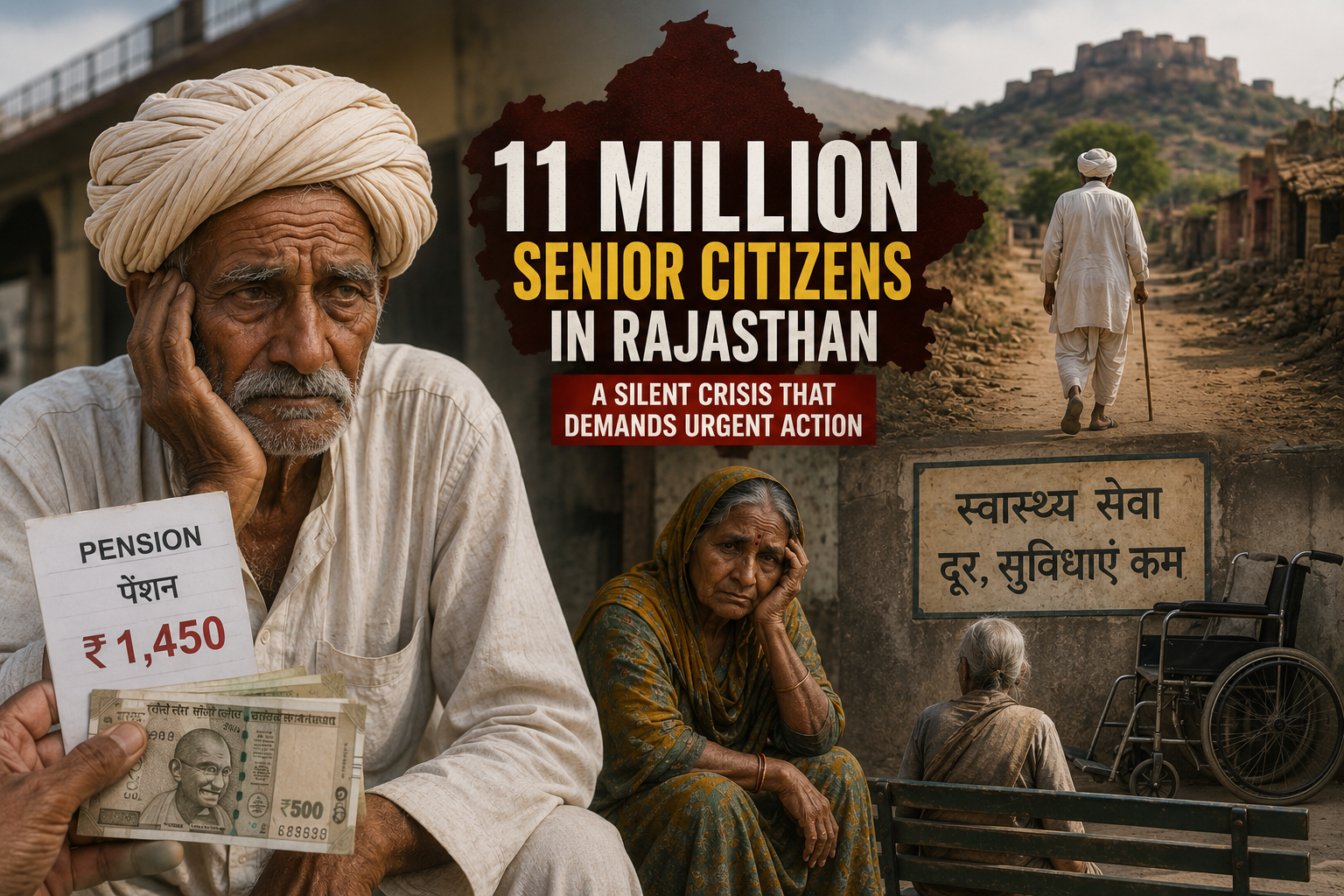


In the bustling markets of Jaipur and the quiet villages of rural Rajasthan, a silent crisis is unfolding that demands our urgent attention. Nearly 11 Mn senior citizens—approximately 10% of Rajasthan’s population—are navigating daily life without adequate financial security, accessible healthcare, or basic social support. This demographic transformation, while reflecting improved healthcare and longevity, has exposed a gaping hole in our social fabric that the state government has yet to adequately fill. As we celebrate Rajasthan’s cultural richness and economic progress, we must confront the uncomfortable truth: our elderly citizens are being left behind.
The issues confronting elderly residents in Rajasthan are not merely isolated problems but form an interconnected web of vulnerability that disproportionately affects women, rural populations, and those without regular income sources. What makes this crisis particularly insidious is its invisibility—these 11 million citizens exist in our communities yet remain largely absent from policy discourse and public consciousness until tragedy forces temporary attention.
Financial Insecurity: When Pensions Don’t Meet Basic Needs
Financial insecurity remains the most pressing concern for senior citizens across Rajasthan, and the current government response feels woefully inadequate to the magnitude of the problem. Approximately 65% of elderly citizens depend primarily on family support or government pensions, yet these pensions remain catastrophically insufficient. The Mukhyamantri Vriddhjan Samman Pension Yojana, despite recent increases from ₹1,150 to ₹1,250 in May 2025 and then to ₹1,300 in January 2026, falls dramatically short of the Koshiyari Committee’s recommended minimum of ₹3,000 plus Dearness Allowance.
Let me be clear: when pensioners in Udaipur publicly protest that amounts as low as ₹78, ₹258, ₹800, or ₹1,653 cannot meet basic needs including food, milk, medicines, and doctor fees, we are witnessing not complaint but desperation. These are citizens who spent their working lives in Rajasthan’s agricultural sector—which employs 70% of the state’s workforce yet rarely provides structured pension arrangements—now facing old age without financial security. The absence of periodic dearness allowance adjustments means the real value of these pensions erodes continuously against inflation, creating a cycle of increasing poverty.
The bureaucratic exclusion mechanisms are equally problematic. Many elderly citizens remain excluded from pension schemes due to documentation challenges, lack of awareness, or the Đan وجود income criteria that still excludes vulnerable populations without BPL, Antyodaya, or Aastha cards. In a state where 60% of the elderly population resides in rural areas with limited access to government offices, these documentation requirements become insurmountable barriers rather than reasonable verification measures.
Healthcare: A System That Cannot Cope With Aging Bodies
Rajasthan’s healthcare crisis for elderly citizens represents one of the most alarming failures in the state’s social infrastructure. With over 70% of elderly individuals suffering from at least one non-communicable disease requiring regular medical attention, the healthcare system’s deficiencies are not merely inconvenient but life-threatening. The CAG report from March 2025 revealed staggering shortages: 40% of doctors missing in state medical college hospitals, 35.5% shortage in primary and secondary facilities, 18.5% nursing staff deficit, and 55.8% paramedic shortage.
The government’s operationalization of Ramashray Wards and Geriatric Clinics in every district hospital by July 2025, with 19.7 lakh senior citizens registered, represents genuine progress and sets a national benchmark. The universal health cover of ₹5 lakh annually for all citizens aged 70+ irrespective of income is equally commendable. However, these initiatives mask fundamental structural problems that continue undermining elderly healthcare access.
The shortage of trained geriatricians remains critical. Most healthcare facilities lack specialists trained in age-related conditions, forcing elderly patients to rely on general physicians unequipped for complex geriatric cases. The rural-urban divide in healthcare access is particularly severe—while Ramashray Wards exist in district hospitals, rural elderly face significant challenges accessing these facilities due to distance, transportation costs, and mobility limitations. Mobile Medicare Units under the Integrated Programme for Older Persons operate at such limited scale that they barely register on the radar of rural healthcare needs.
The mental health crisis among elderly citizens receives virtually no attention. Depression, anxiety, and cognitive decline remain underdiagnosed and untreated, with only a few urban centers offering specialized care. This neglect is particularly disturbing given that social isolation affects approximately 11.4% of elderly residents, with 28.7% experiencing family neglect and 15.5% reporting ill-treatment. The psychological consequences—chronic depression, accelerated cognitive decline, diminished life satisfaction—compound physical health problems in ways that the healthcare system cannot address.
Social Isolation: The Erosion of Traditional Support Systems
The traditional multi-generational family structures that historically cared for elderly parents are eroding across Rajasthan, driven by youth migration to urban centers, preference for nuclear family arrangements, and overwhelming economic pressures on working-age family members. This phenomenon, known as “elderly left-behind,” has created a significant population of isolated seniors lacking daily family support, particularly in rural areas where transportation infrastructure is poor and community centers are scarce.
The Agewell Foundation’s survey conducted during World Elder Abuse Awareness Day revealed shocking statistics: 69% of elderly respondents from Rajasthan said abuse cases increased during lockdown and continued afterward, 33% claimed they faced domestic violence, 62% were facing neglect, and 59% reported suffering abuse in families and society. Most disturbingly, 79.5% reported adverse life impacts during the COVID situation, with sons (42%) and daughters-in-law (28%) identified as primary perpetrators. These are not abstract statistics but descriptions of daily humiliation and suffering experienced by millions of our citizens.
The psychological consequences of this isolation are profound. Chronic loneliness contributes to high rates of depression among elderly populations that often go undiagnosed and untreated. Social isolation accelerates cognitive decline and increases dementia risk. The absence of emotional support and social interaction significantly diminishes overall life satisfaction. Isolated elderly individuals become more vulnerable to exploitation, abuse, and financial fraud due to lack of protective family oversight.
In rural areas, the situation is particularly acute. Traditional community support mechanisms have weakened without adequate replacement by modern institutional supports. Digital connectivity limitations prevent virtual social engagement, while the scarcity of elderly clubs and community centers eliminates opportunities for social interaction. The result is a generation of citizens growing increasingly isolated in their own communities.
Safety and Abuse: The Criminalization of Elderly Vulnerability
Rajasthan’s failure to ensure safety and security for its elderly population represents a moral catastrophe that demands immediate attention. The NCRB 2023 Report revealed a disturbing 98% surge in crimes against elderly persons—from 278 cases in 2022 to 553 cases in 2023, including 12 murders and 114 fraud cases targeting elderly victims. In districts like Alwar, Bharatpur, Dausa, and Sawai Madhopur, crimes against senior citizens remain common and major challenges for state police.
Elder abuse manifests in multiple devastating forms. Physical abuse includes hitting, pushing, or restraining causing physical pain. Psychological abuse involves verbal assaults, threats, and humiliation causing emotional pain. Financial abuse includes theft, fraud, and misuse of money or assets. Neglect—the failure to provide necessary care including food, shelter, healthcare, or social interaction—affects 62% of elderly respondents. Sexual abuse and institutional abuse in nursing homes complete this grim picture.
Certain groups face heightened vulnerability: illiterate elderly, those with annual income below ₹100,000 (73% of abused elderly), those with chronic diseases (94% of abused elderly), rural elderly, and males aged 75+. Despite legal protections under the Maintenance and Welfare of Parents and Senior Citizens Act, underreporting remains rampant due to family privacy concerns and fear of retaliation. Many elderly citizens approach lawyers with complaints of abuse by their own children, but formal police reporting remains low.
The lack of specialized police units for handling elderly crime cases, combined with investigation delays and limited awareness about legal protections, creates an environment where perpetrators operate with minimal consequence. This systemic failure transforms vulnerable elderly citizens into criminal victims without effective recourse.
Digital Exclusion: The New Form of Age-Based Discrimination
The rapid digitalization of public service delivery in India has inadvertently created a new form of age-based discrimination that excludes large segments of the elderly population, particularly in Rajasthan. A 2025 study revealed that only 23% of elderly respondents reported confidence in independently accessing digital services, while 67% relied on family members or paid intermediaries. Urban seniors demonstrated higher digital literacy (31%) compared to rural counterparts (14%), with women facing more severe digital exclusion due to social, educational, and mobility constraints.
This digital exclusion has severe consequences for elderly citizens’ ability to access essential services. Pension disbursements have shifted to digital DBT systems, creating barriers for elderly citizens unable to navigate banking apps. Healthcare services increasingly require online registration for hospital appointments, digital prescriptions, and telemedicine platforms. Most welfare schemes now require online application processes, excluding elderly citizens who cannot complete digital forms. Financial transactions through digital payments and online banking limit independent elderly financial management. Emergency services accessible through digital platforms become impossible for non-digital-literate elderly individuals.
The barriers preventing digital access are multifaceted: complex user interfaces with complicated navigation, lack of Hindi or regional language support, minimal age-appropriate training opportunities, physical limitations including reduced vision and motor control challenges, and the prohibitive cost of smartphones and internet connectivity for pension-dependent elderly citizens. Existing digital literacy programs fail to adequately cater to the elderly demographic, particularly in rural Rajasthan, creating a technological divide that mirrors and amplifies existing socioeconomic inequalities.
Transportation and Housing: Barriers That Trap Elderly Citizens
Transportation access remains a critical barrier for elderly citizens in Rajasthan, particularly those with mobility limitations. The state’s vast geography combined with inadequate public transportation infrastructure creates significant challenges. Most public transportation vehicles lack accessibility features such as ramps, priority seating, or assistance for elderly passengers. Rural elderly citizens face significant distances to reach healthcare facilities and government offices with limited transportation options. Despite RSRTC’s concession schemes offering 50% discounts for ages 60-80 and free travel for 80+, documentation requirements, RFID card processes, and limited coverage create bureaucratic hurdles that many elderly cannot navigate.
Age-related physical limitations compound these transportation challenges. Arthritis, muscle weakness, reduced vision, and hearing impairments make navigating public transportation systems difficult and increase safety risks. The fear of falling or accidents while using public transportation leads many elderly citizens to self-restrict their movement, further increasing isolation and limiting access to essential services.
Housing insecurity presents equally daunting challenges. Many elderly citizens face property disputes with family members leading to uncertain housing situations. Rural elderly frequently live in poorly constructed homes lacking basic amenities. Those without property who must rent face significant financial burdens as pension amounts rarely cover rental costs. While the state operates 63 old-age homes as of October 2025, this capacity cannot accommodate the growing number of destitute elderly citizens, creating long waiting lists. Geographic concentration in urban areas leaves rural elderly without access to residential care options, while quality concerns and cultural stigma prevent many eligible elderly from seeking admission even when family support is absent.
The Gender Dimension: Why Elderly Women Face Compounded Disadvantages
Elderly women in Rajasthan face compounded challenges due to gender discrimination extending throughout their lives. Women often have irregular employment histories reducing eligibility for formal pension schemes. Higher widowhood rates resulting from women outliving men create greater financial insecurity. Women face more severe digital exclusion due to social, educational, and mobility constraints. Elderly women face higher rates of osteoporosis, arthritis, and age-related conditions requiring specialized care. Widowed elderly women often experience greater social isolation due to cultural norms limiting public participation. Despite legal provisions, elderly women frequently face challenges claiming property rights, leaving them housing-insecure. Studies indicate that 37.85% of elderly women report severe financial difficulties compared to male counterparts, revealing the gendered dimension of elderly poverty.
Existing Initiatives: Progress That Remains Insufficient
The Rajasthan government has demonstrated commitment through multiple initiatives: pension increases, Ramashray Wards in all district hospitals, universal health coverage for 70+, transportation concessions, the Senior Citizen Pilgrimage Scheme, day care centers, and 63 old-age homes. The integrated approach involving food, health, transport, and devasthan departments shows coordination. However, these initiatives remain insufficient relative to the scale of challenges. Pension amounts remain inadequate, rural coverage gaps persist across most programs, digital transition excludes elderly without technology access, implementation delays and bureaucratic hurdles limit effectiveness, specialized geriatric training among healthcare personnel remains insufficient, monitoring and evaluation mechanisms are inadequate, and awareness among target populations remains limited.
A Path Forward: Transformative Interventions We Must Demand
Rajasthan needs transformative interventions that fundamentally reshape elderly care infrastructure. Pension amounts must increase to ₹3,000 with periodic Dearness Allowance adjustments. Universal pension coverage removing all income criteria is essential. The healthcare system requires 500 trained geriatricians within 5 years, enhanced rural healthcare through Mobile Medicare Units, expanded free medication distribution, dedicated geriatric mental health clinics, and equipped rural diagnostic facilities. Community elderly centers in every village panchayat, family support programs with caregiver training, volunteer matching systems, and anti-isolation campaigns can reconstruct social support systems.
Dedicated Elder Crime Special Units in all district police headquarters, strengthened legal protection mechanisms, emergency shelters for abused elderly, and statewide awareness campaigns can prevent elder abuse. Elderly-focused digital literacy programs training 500,000 citizens within 3 years, simplified government portals with elderly-friendly interfaces, human assistance centers at all government offices, and subsidized smartphone distribution can achieve digital inclusion. Accessibility infrastructure mandating ramps and priority seating, simplified concession schemes eliminating RFID requirements, and enhanced rural transportation frequency can improve transportation access. Old-age home expansion from 63 to 200 facilities within 5 years, housing modification subsidies, and strengthened property rights protection can ensure housing security.
The Moral Imperative: Why Rajasthan Must Act Now
The well-being of Rajasthan’s 11 million elderly citizens is not merely a social welfare issue but a moral imperative reflecting the state’s values and commitment to all residents throughout their lives. As the elderly population continues growing, the state’s response will determine whether senior citizens live with dignity, security, and quality of life or face increasing vulnerability and neglect. The time for incremental improvements has passed. Rajasthan needs transformative interventions that demonstrate aging populations can be supported with dignity, respect, and comprehensive services ensuring quality of life in senior years. Our forgotten elders deserve nothing less than our full commitment to their welfare.