




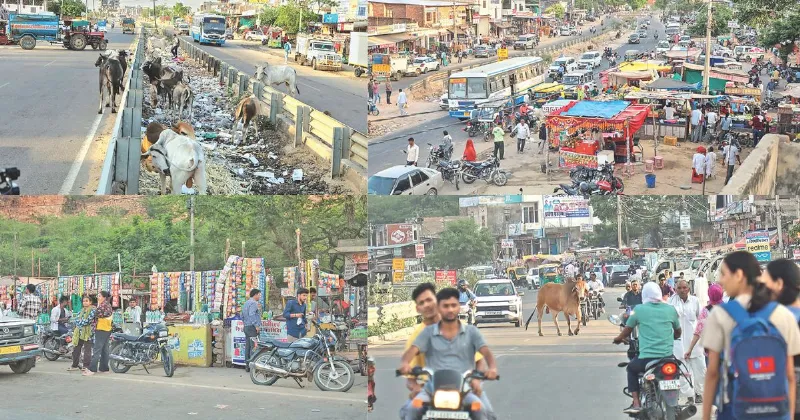


The Achrol stretch of National Highway‑48 is no longer just a traffic corridor; it has become a visible record of institutional failure. The six‑lane, high‑speed highway gives way to disorder, encroachments and uncontrolled traffic, even as the land formally belongs to the Jaipur Development Authority (JDA), the road is under the National Highways Authority of India (NHAI) and traffic control rests with the Jaipur Police. The core question that haunts the stretch is: in a system that splits responsibility across three powerful bodies, who is actually accountable for the chaos at Achrol?
JDA: Authority on Paper, Lenience on Ground
Achrol falls squarely under the planning and land‑use jurisdiction of the Jaipur Development Authority, which legally has the power to regulate land use, remove encroachments and manage development. On paper, JDA has even formed a Traffic Control Board and carries out anti‑encroachment drives in parts of the city. However, on the Delhi‑Jaipur highway, the reality is starkly different. Hotels, roadside eateries, shops and warehouses flourish along the right‑of‑way, while service lanes—meant for local traffic—are either missing or eaten up by concrete structures. The recurring pattern has turned what looks like simple neglect into what many now call an institutional habit of silence—where taking no action is easier than enforcing the law.
This is compounded by the fact that JDA’s traffic‑related measures never seem to cross the informal “city limit.” The JDA Traffic Control Board functions largely within Jaipur, while the Delhi‑road corridor beyond, including Achrol, remains outside effective monitoring. There is no visible system of smart surveillance, traffic management or lane‑based regulation on this stretch, even though the volume of commuters, private buses and state‑transport buses through this stretch is high. The result is ad‑hoc U‑turns, illegal median cuts and vehicles moving in the wrong direction, all of which push accident risk up.
Police Lane System: Applied Selectively
The Jaipur Police introduced a lane‑system policy on major highways, arguing it would improve road safety and discipline. The system is clearly visible and enforced on Sikar Road and Ajmer Road, with marked lanes, signage and police presence. Yet, the same principle is almost invisible on Delhi Road, where Achrol sits. There is no lane‑demarcation, little enforcement and minimal coordination between the traffic wing and the JDA or NHAI. The lane rule thus appears not as a uniform policy but as a selective display of optics, where compliance is demanded only where it is easier to showcase and ignore where it is politically or logistically messy.
NHAI: Framework without Enforcement
Under the Right of Way (ROW) rules, NHAI prohibits construction up to 60–75 metres on either side of national‑highway medians, and the Rajasthan High Court has recently ordered the removal of thousands of encroachments within this zone. However, at Achrol, the same norms are routinely violated. Unauthorised cuts, hotels and warehouses stand right against the highway, and service lanes are blocked or misused. The fact that such violations have persisted for years suggests either a serious gap in monitoring or a willingness to turn a blind eye. NHAI’s technical framework is clear; what is missing is the will to enforce it in a way that treats the highway as a life‑safety corridor, not a real‑estate opportunity.