






For entrepreneurs, registering a company, filing a tax return or protecting a trademark is not an ordinary online purchase. These services affect deadlines, legal rights and the survival of a business. Customers are therefore not merely paying for access to a digital platform; they believe they are paying for professional guidance and the successful handling of a sensitive process.
This expectation lies at the centre of the growing debate around IndiaFilings.
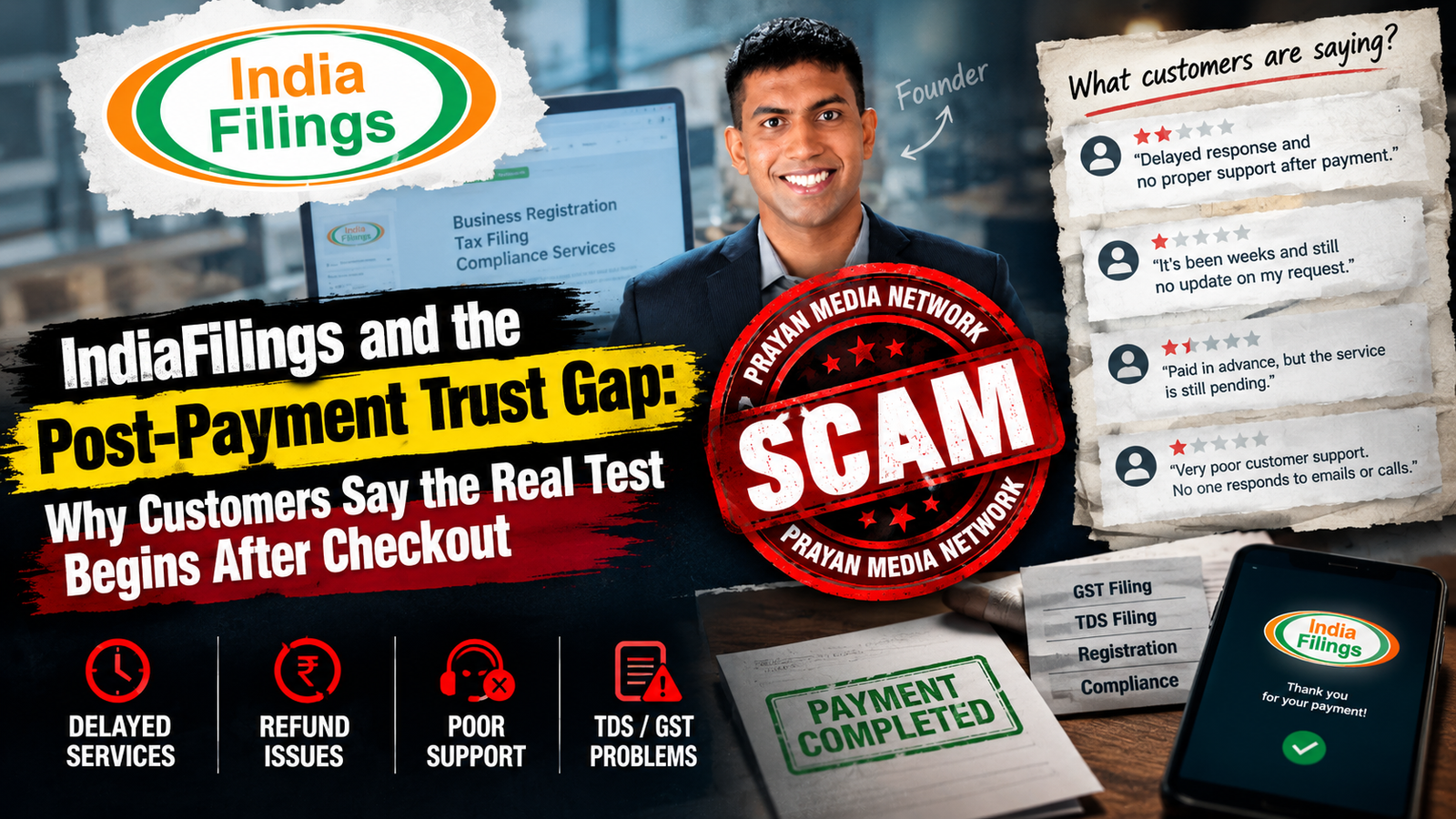
The company promotes itself as a technology-enabled platform for business registration, taxation, intellectual-property protection and regulatory compliance. Its own website features a large volume of positive feedback, including praise for helpful employees, clear explanations and smooth registration support. On independent platforms, however, many customers tell a sharply different story. They allege that the company is highly responsive while collecting payment but becomes difficult to reach when work is delayed, a filing encounters a problem or a refund is requested.
The controversy is not only about whether one trademark application or GST registration was delayed. It concerns a wider question: what exactly is a customer buying when professional services are packaged and sold like an online product?
Two versions of the customer experience
IndiaFilings’ own review pages present an overwhelmingly positive picture. Customers frequently praise individual employees for being polite, supportive and professional. Many comments describe quick responses, useful guidance and satisfactory assistance with trademark or company-registration work.
Independent review platforms show a more divided experience. Trustpilot displayed a score of 3.0 out of 5 from 1,174 reviews when examined for this report. Its rating distribution was highly polarised: 59% of reviews were five-star, while 34% were one-star. Only a small proportion fell between those two extremes.
Such a split suggests that IndiaFilings may not deliver a consistently poor service to everyone. Instead, it indicates a system in which some engagements move smoothly while others appear to break down badly. Customers whose applications are straightforward may receive efficient assistance, but those facing objections, missing documents, reassignment or refund requests may find it much harder to obtain ownership and resolution.
That difference is crucial. A professional-services company should not be judged only by how it handles routine cases. Its true test is how it responds when something goes wrong.
The broken handoff
One recurring theme in customer complaints is what may be described as the “post-payment handoff.” Before payment, customers say they receive repeated calls, confident timelines and assurances that the process will be handled. After payment, the matter may pass from a salesperson to an engagement manager, auditor, filing executive or support agent.
Customers allege that this transition often creates confusion. They report being asked to explain the same problem to multiple employees, receiving different answers and struggling to identify the person ultimately responsible for completing the work.
This could explain why some consumers feel abandoned even when activity may still be occurring inside the company. A service can be technically in progress while the customer experiences complete silence. In compliance work, however, silence is not a minor inconvenience. If a trademark objection, tax notice, hearing date or statutory deadline is involved, the absence of a clear update can create financial and legal anxiety.
A recent Google Play reviewer said company registration was urgently required and that the platform gave the impression that the process could be completed in around ten days. The reviewer alleged that more than a week passed without even the basic application being submitted. IndiaFilings replied publicly, apologised and asked the customer to share registered contact details for assistance.
The response shows that the company does engage with at least some complaints. It also raises another question: why must a customer post a negative public review before receiving focused attention?
Selling speed in a slow system
IndiaFilings operates in an area where no private company controls the entire process. Company incorporation, trademark registration, GST, tax filings and licences depend on government portals, officials, statutory requirements and the accuracy of documents submitted by customers.
Government delays are real, and an application can be rejected or returned for reasons outside the service provider’s control. IndiaFilings expressly states in its policies that it cannot guarantee particular outcomes and is not responsible for delays caused by government agencies, external platforms or incomplete customer information.
That explanation is reasonable up to a point. A professional service provider cannot promise that a government department will approve every application within a fixed period. But customers are not only complaining about government processing times. They are alleging delays in submission, insufficient updates, missed follow-ups, changing representatives and uncertainty about whether action was taken at all.
The distinction is important. A delay after an application has been correctly filed is different from a delay before submission. A government rejection is different from an incorrect filing. An unavoidable objection is different from failing to alert the customer in time.
Companies selling compliance services should separate these stages clearly. Customers should be able to see when documents were received, when they were reviewed, when an application was submitted, which authority is handling it and what action is currently pending.
When “platform access” replaces completion
The most revealing part of IndiaFilings’ published refund policy is not the 20% cancellation charge or the stated processing period of three to five weeks. It is the provision saying that the company considers its service obligation fulfilled once access to the platform has been granted.
That wording may be legally significant, but it does not necessarily match the understanding of an ordinary customer. A founder paying for “company registration” is likely to believe the payment covers professional assistance toward registration, not simply entry to a software interface. A shop owner paying for a GST service may expect a filing to be prepared and submitted, not merely the ability to communicate through a portal.
If IndiaFilings is selling platform access, that limitation should be displayed prominently before payment. If it is selling managed professional services, customers should receive clearly defined deliverables. Combining the language of a full-service professional engagement with terms that limit the obligation to platform access risks creating an expectations gap.
This gap may be one reason customers use words such as “scam,” “fraud” or “cheat” in emotional online reviews. Those descriptions remain allegations and have not been established as company-wide facts by a court or regulator. Nevertheless, they show the depth of frustration among people who believe the service they received was fundamentally different from the service they thought they had purchased.
Refunds become a second dispute
For dissatisfied customers, ending an engagement does not always end the problem. Reviews describe refund requests involving deductions, long processing periods, repeated follow-ups or offers of service credits instead of cash.
IndiaFilings says refund requests may be made within 30 days, generally carry a 20% cancellation charge and are processed after the required information has been supplied. The policy also excludes several circumstances, including government delays and outcomes beyond the company’s control.
From a consumer perspective, the difficulty is determining how much work has actually been completed. If a company claims that internal effort or platform access justifies a deduction, the customer should receive an itemised account showing what was done, when it was done and how the deduction was calculated.
At least one reviewer said escalation through the National Consumer Helpline resulted in payment of a larger refund after the initial amount was challenged. That account suggests formal documentation and escalation can be more effective than repeated telephone calls.
A trust problem, not only a service problem
The strongest defence of IndiaFilings is that thousands of customers report satisfactory service and that regulatory work is inherently unpredictable. The strongest criticism is that too many dissatisfied customers describe the same post-payment communication failure for their experiences to be treated as isolated misunderstandings.
Both realities can exist at once. A company can complete a large number of engagements while still having serious weaknesses in escalation, workload management and accountability. Positive reviews do not cancel negative experiences, just as negative posts do not prove every transaction is deceptive.
The larger issue is trust. Customers hand over business documents, personal information, tax records and intellectual property to platforms such as IndiaFilings. They must be able to see who is responsible for their case and whether a deadline has been met.
IndiaFilings could address the criticism by introducing a public service charter. Every engagement should display an itemised price, realistic timeline, assigned case owner, document checklist, filing acknowledgement and escalation officer. Refund requests should have a visible status and a written calculation of deductions.
Customers, meanwhile, should protect themselves before making payment. They should request the complete scope in writing, ask whether government charges are included, confirm who will perform the work and demand the official acknowledgement number after submission. Promises made over a call should be confirmed by email or message.
If the service remains unresolved, customers should preserve invoices, chats, emails, call records and portal screenshots. A written grievance should specify the payment, promised service, deadline, work completed and remedy sought. The matter may then be escalated through the company’s grievance officer, the National Consumer Helpline or an appropriate legal forum after professional advice.
The debate around IndiaFilings is ultimately about the changing nature of online professional services. Technology can make compliance faster and more accessible, but it cannot replace responsibility. A dashboard is not accountability, an automated update is not communication and a sales promise is not service delivery.
IndiaFilings may be able to repair its reputation, but doing so will require more than collecting positive ratings. It must show dissatisfied customers what happened after their payment—and who is responsible for fixing it.
*Disclaimer: The information presented in this article/content is based on reports, claims, statements, and materials available from external sources. We have not independently verified the accuracy, completeness, or authenticity of any information. Readers are advised to exercise their own judgment and refer to official sources for confirmation.