



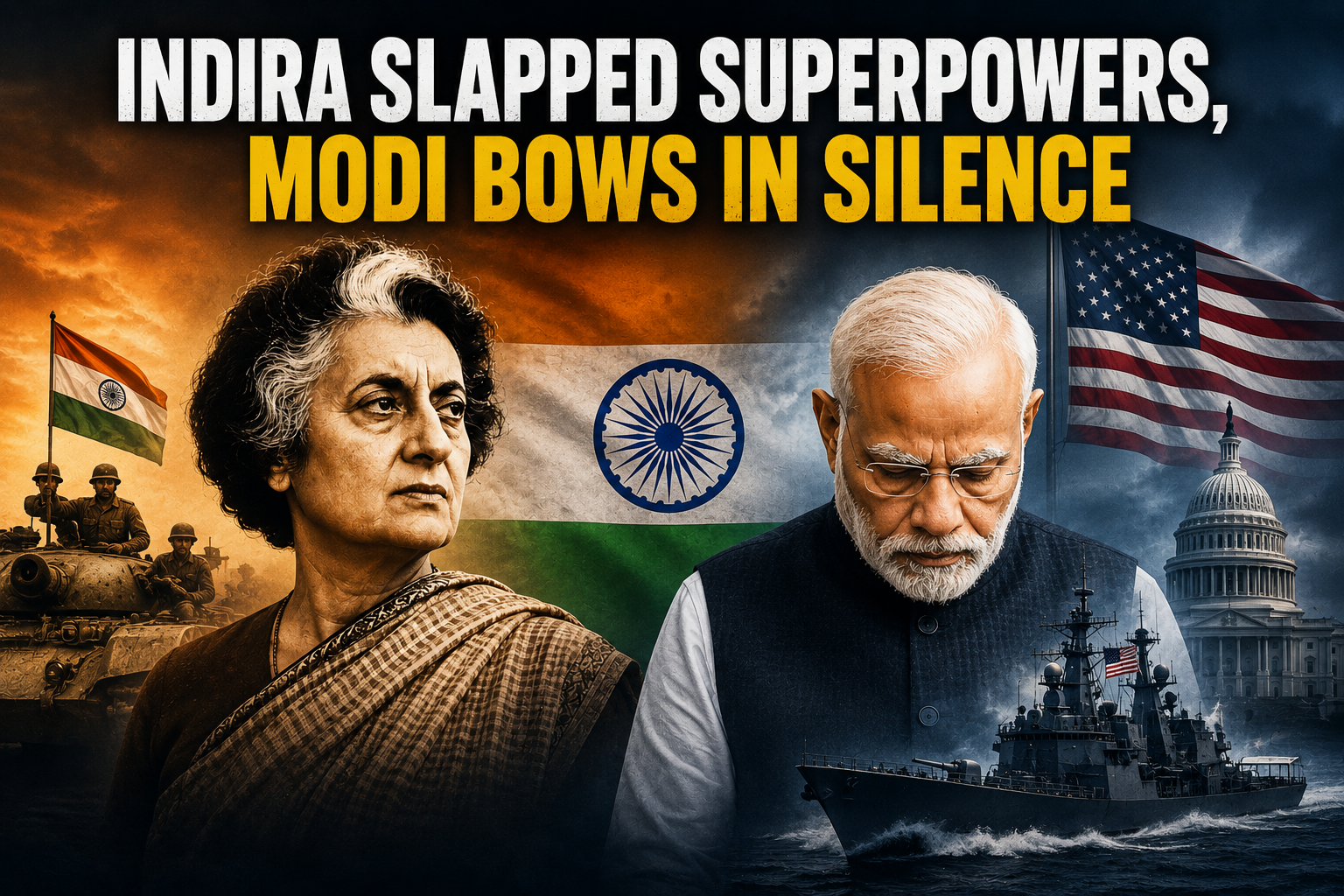


In an age where nations earn respect through conviction, clarity, and the courage to defend their interests, many observers find themselves comparing the assertive leadership of Congress under Indira Gandhi with the approach adopted by Narendra Modi and the BJP today. Indira Gandhi, often remembered as the “Iron Lady” of India, projected an image of strength and determination that resonated both at home and abroad. In contrast, critics argue that the current government has struggled to demonstrate the same firmness when Indian lives are affected by international actions.
Indira Gandhi inherited a young and developing nation during a period marked by economic challenges, food shortages, regional tensions, and intense Cold War rivalries. Yet she transformed India into a country that commanded attention on the global stage. Her leadership during the 1971 war remains one of the defining moments in modern Indian history. Despite pressure from powerful nations, including the United States under President Richard Nixon, and the deployment of the USS Enterprise to the Bay of Bengal, she remained steadfast. The Indo-Soviet Treaty provided India with strategic support, and the decisive 13-day war led to the creation of Bangladesh. India did not merely seek recognition—it established itself as a regional power.
At home, the Congress government under Indira Gandhi pursued ambitious policies aimed at strengthening the nation’s economic foundation. Bank nationalisation expanded access to financial services, the Green Revolution helped address food insecurity, and India pursued greater economic self-reliance. While economic growth remained modest by today’s standards, the country laid the foundations for strategic independence, including its nuclear program, demonstrated through the Pokhran-I test in 1974. Supporters viewed her as a leader who placed national interests and Indian citizens at the center of policymaking, even as critics questioned some of her methods.
Fast forward to 2026, and critics of the current government see a starkly different picture. The deaths of three Indian sailors—P. Suresh, Aditya Sharma, and Shivanand Chaurashiya—in US strikes on oil tankers operating in the Gulf of Oman have sparked concern and anger. These incidents occurred amid broader tensions surrounding Iran-linked shipping routes, with vessels carrying Indian crew members reportedly coming under attack. While India lodged diplomatic protests and engaged with American officials, critics question whether the country’s political leadership responded with the urgency and public resolve that such a tragedy demanded.
Opposition leaders, including Rahul Gandhi, have argued that the government should have taken a stronger and more visible stand in defense of Indian citizens. They contend that if Indian lives are lost in international conflicts, the country deserves a clear and forceful response from its highest elected leadership. For them, silence or limited public engagement risks sending the wrong message about India’s willingness to protect its people abroad.
The contrast becomes even sharper when viewed through a strategic lens. During Indira Gandhi’s tenure, India often faced sanctions, external pressure, and diplomatic isolation, yet sought to build resilience through self-reliance and independent decision-making. Today’s India enjoys stronger economic growth, expanding infrastructure, and greater integration into the global economy. However, critics argue that economic progress alone cannot substitute for decisive leadership during moments of national crisis.
India is among the world’s leading suppliers of maritime professionals, with hundreds of thousands of Indian seafarers working across international waters. Yet questions arise when incidents involving Indian citizens fail to trigger a response that matches the government’s ambitious global narrative. Critics ask whether India’s growing influence on the world stage is translating into greater protection and security for its people.
Supporters of the Congress legacy often point to Indira Gandhi’s ability to combine strong foreign policy with domestic welfare initiatives. Programs such as Garibi Hatao were presented as efforts to directly address poverty and social inequality. By comparison, critics of the BJP argue that issues such as unemployment, rising inequality, and concerns about corporate influence have weakened the government’s claim of inclusive development. They also contend that foreign policy has sometimes appeared stronger in symbolism than in accountability.
For these critics, the deaths of Indian citizens abroad represent more than an isolated tragedy. They symbolize a broader concern about whether the government is willing to assert India’s interests when confronted by powerful international actors. They argue that strategic patience should not come at the cost of visible accountability and national self-respect.
The larger debate, therefore, is not simply about one incident or one government. It is about competing visions of leadership. One vision emphasizes assertiveness, strategic independence, and an uncompromising defense of national interests. The other prioritizes diplomacy, economic partnerships, and long-term engagement. Critics of the current administration believe the balance has shifted too far toward caution and symbolism.
As the families of the deceased sailors seek answers and justice, the debate over India’s global standing continues. For many, the legacy of Indira Gandhi remains a benchmark for decisive leadership during moments of crisis. Whether that comparison is fair or not, it continues to shape public discussions about what strong leadership should look like in contemporary India.
*Disclaimer: The views expressed are solely those of the author and are not endorsed by Prayan Media Network or any of its members.