




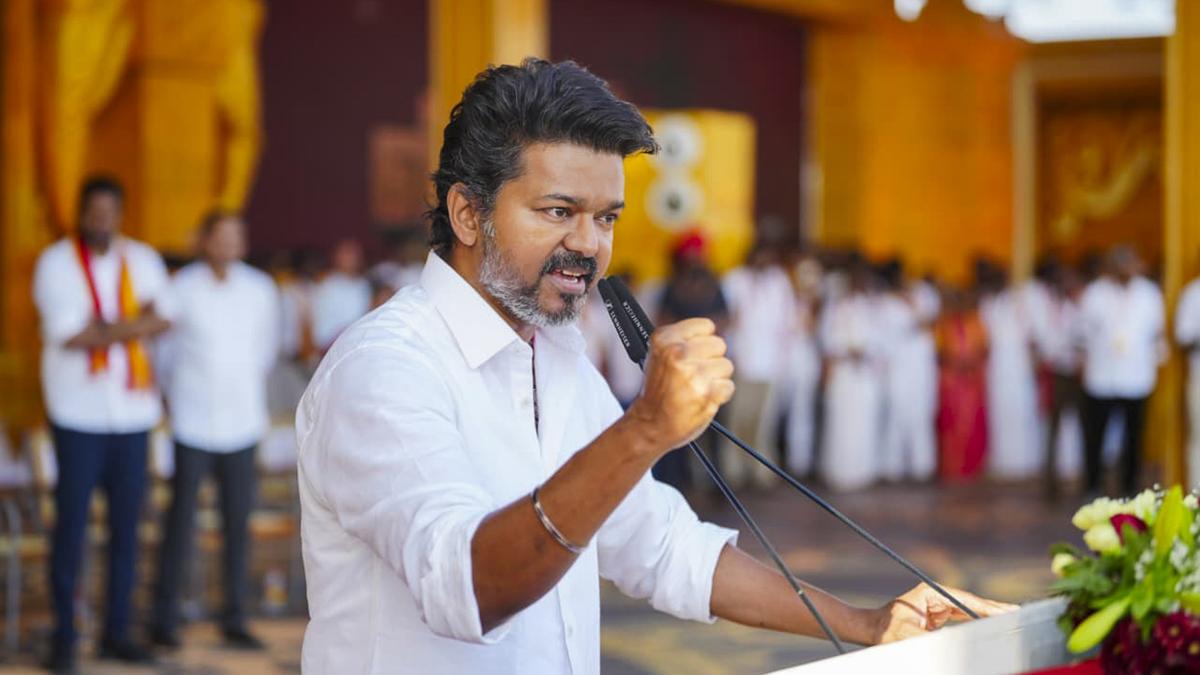


For millions of fans, it was the moment their favourite star stepped into his biggest role yet. For political observers, it marked the beginning of an entirely new chapter. Yet, winning an election was only the first challenge. The real test began once Vijay entered Fort St. George. Governing a state with huge financial pressures, a strong opposition and a politically different Union government meant every decision would be closely watched. Instead of choosing confrontation or political theatrics, Vijay has attempted something different a governance model built on ideology, practicality and administrative discipline.
Whether it ultimately succeeds remains to be seen, but one thing is already clear: Tamil Nadu politics is no longer following its old rulebook.
A Government Built on Principles
Long before becoming Chief Minister, Vijay repeatedly spoke about creating a politics centred on equality, transparency and social justice. Rather than positioning TVK as another personality-driven political outfit, he sought to build its identity around the ideals of Periyar E.V. Ramasamy, Dr. B.R. Ambedkar and K. Kamaraj. These ideological influences shaped the government’s early decisions.
From ensuring greater representation for Scheduled Castes in the Cabinet to giving women significant ministerial responsibilities, the administration tried to demonstrate that inclusivity would be more than just an election slogan. Supporters argue these appointments reflected TVK’s promise of creating a government that represents every section of society instead of concentrating power among a select few.
Drawing a Clear Line Between Politics and Governance
Perhaps Vijay’s most surprising political move has been his approach toward the Central government. Although TVK remains ideologically opposed to the BJP on several national issues, Vijay has repeatedly stated that political disagreement should not come at the cost of administrative cooperation. His message has been simple. A state government can oppose policies it disagrees with while continuing to work with New Delhi on infrastructure, investment and welfare projects that directly benefit people.
This approach represents a noticeable departure from the politics of constant confrontation. For Vijay, the focus appears to be less about winning television debates and more about ensuring Tamil Nadu receives every opportunity available for economic growth. Many political analysts describe this as one of the defining characteristics of the new administration.
Tackling an Economic Challenge
One of the biggest hurdles facing the TVK government is the state’s financial health. Soon after taking office, the administration released a financial assessment highlighting a large revenue deficit and mounting public debt inherited from previous governments. Rather than making new populist promises, Vijay’s government chose to emphasise fiscal responsibility.
Cabinet meetings increasingly centred on revenue generation, efficient public spending and attracting fresh investments into Tamil Nadu. Officials argued that difficult financial decisions taken today would strengthen the state’s economy over the coming years. While such measures may not always be politically popular, the government believes they are necessary to ensure long-term stability.
Answering Critics Head-On
No new government escapes criticism, and TVK has been no exception. The opposition questioned whether Vijay’s coalition possessed the strength and unity required to govern effectively. Some even claimed the government survived only because of political convenience shown by rival parties. Vijay responded strongly inside the Assembly.
He reminded legislators that his coalition had secured the numbers required to form the government through democratic means and insisted that TVK owed its position solely to the people who voted for change. According to Vijay, coalition politics should never be mistaken for political weakness. Instead, he described it as a mature system where different parties work together while respecting one another’s identities. That message resonated strongly with supporters who viewed the coalition as a symbol of inclusive governance rather than compromise.
A Push for Structural Reform
If there is one area where the TVK government wants to distinguish itself, it is administrative reform. Instead of announcing headline-grabbing welfare schemes every few weeks, the administration has focused on restructuring institutions. Several commercial projects involving temple properties were reviewed, with the government arguing that religious assets should primarily serve their intended social and cultural purposes. The administration also intensified efforts against organised crime, narcotics and crimes against women.
The formation of the specialised Singappen Special Force was presented as part of a wider strategy to strengthen law enforcement while improving women’s safety across the state. At the same time, government departments were instructed to improve financial accountability and prevent leakages in public spending. The overall objective, according to the administration, is to create a government where public money is protected and used more efficiently.
A Different Leadership Style
Observers have also noted Vijay’s leadership style. Unlike traditional political veterans, he has often preferred shorter public speeches and direct communication. His political messaging focuses less on attacking opponents and more on explaining government decisions. Supporters believe this straightforward approach makes governance feel more accessible. Critics, however, argue that effective communication must eventually be matched by measurable results on the ground. As expectations continue to rise, every decision made by the Chief Minister will face intense public scrutiny.
The Beginning of a New Political Story
Whether one supports TVK or not, few can deny that Vijay has already altered Tamil Nadu’s political conversation. His administration seeks to combine ideological conviction with administrative pragmatism, choosing cooperation where possible while maintaining firm political positions where necessary. It is an ambitious balancing act.
If successful, it could reshape how coalition governments function in the state and inspire a different model of leadership for regional politics. For now, Tamil Nadu finds itself witnessing a remarkable political experiment. The actor who once inspired audiences through cinema is now attempting to inspire them through governance.
History will ultimately decide whether this experiment becomes a lasting success, but one thing is certain: under Vijay’s leadership, Tamil Nadu politics has entered an entirely new chapter, and the story is only just beginning.