




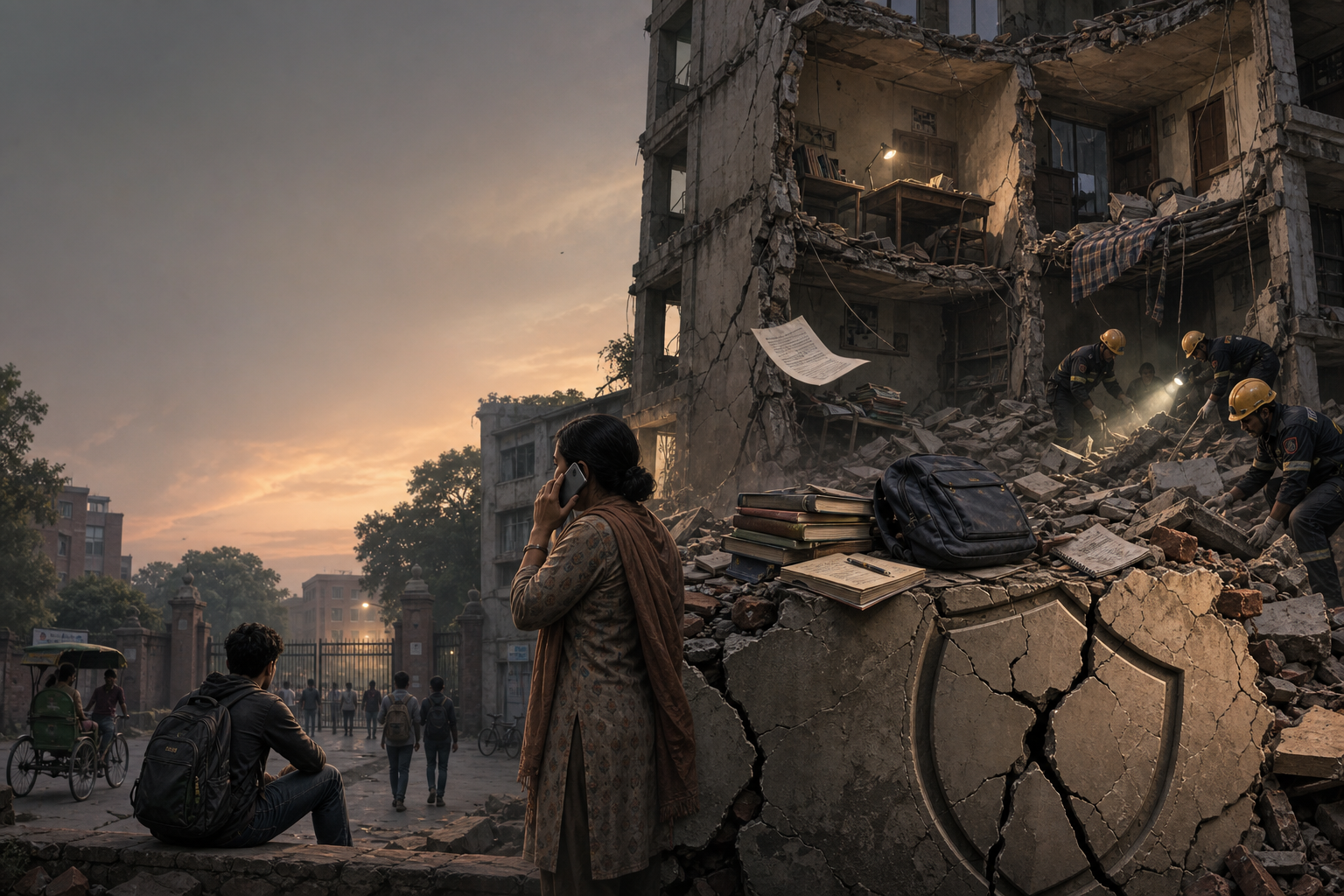


The collapse of a boys’ PG building in Satya Niketan is not only a tragedy—it is a chilling warning for every student living away from home in Delhi. One life has already been lost, several people have been injured, and students were feared trapped beneath the debris of a building meant to provide them shelter near Delhi University’s South Campus.
The question Delhi must confront is simple and painful: How will the government bring back the students who were lost, injured or traumatised under the rubble?
No compensation, announcement, inquiry or official assurance can return a child to a family that sent them to Delhi with dreams of education. Parents send their sons and daughters to the capital carrying books, admission letters and hope. They do not send them into buildings where safety may depend on the strength of an old wall, an unapproved alteration or the absence of timely inspections.
A City Built on Student Dreams
Delhi is one of India’s biggest education hubs. Students from Rajasthan, Uttar Pradesh, Bihar, Haryana, Punjab, Madhya Pradesh and across the country arrive here every year for Delhi University, coaching institutes, professional courses and competitive examinations.
But university hostels do not have enough rooms for everyone. Private PGs, rented flats and hostels fill that gap. In neighbourhoods around North Campus, South Campus, Satya Niketan, Mukherjee Nagar, Laxmi Nagar, Rajinder Nagar and other education clusters, student accommodation has become a large business.
The problem is that many students and parents have no practical way to know whether a PG building is structurally safe. Is the building approved for its present use? Has it undergone a structural audit? Does it have a fire clearance certificate? Are there emergency exits? Is the number of residents within the legal capacity? Are basements, terraces and rooms being illegally altered to accommodate more paying tenants?
These should not be questions parents need to ask after an accident. They should be answered before a student signs a rent agreement.
Questions for PM Modi
Prime Minister Narendra Modi often speaks about India’s youth as the country’s strength, its future and the foundation of a developed nation. But what does that future mean for a student buried under rubble in a PG building near a university campus?
Will the Prime Minister visit Delhi University and Satya Niketan? Will he meet the students rescued from the debris and the families waiting outside hospitals? Will he ask why young people who came to Delhi to study were living in a building that could collapse over them?
Will the Centre seek a nationwide review of student housing standards in major education cities? Or will the tragedy be reduced to another headline, followed by condolences, compensation and silence?
A government that celebrates youth must also protect the spaces where young people sleep, study and prepare for their future.
Questions for Delhi Government
The Delhi government and civic authorities have an equally direct responsibility. How many PG buildings are operating across Delhi? How many have valid structural stability certificates? How many are registered, inspected and compliant with fire, safety and occupancy norms?
How many buildings in student localities have been checked for illegal construction, excessive floors, weak foundations, unsafe renovations and unauthorised basement work? How many are being used as commercial PGs despite being designed as residential houses?
Most importantly, why should students and their parents be expected to discover safety failures on their own?
The government must explain what it will do now—not merely after an inquiry report arrives months later. It must answer how it plans to prevent another student from being trapped beneath the ceiling of the room they pay rent for every month.
Safety Cannot Be Optional
The Satya Niketan collapse should compel authorities to launch an immediate, transparent and citywide safety audit of PGs, hostels and student rental accommodations.
The audit must not be limited to a few high-profile localities or carried out as a symbolic exercise. It should cover every building used to house students and publicly disclose whether it has:
-
A valid structural stability certificate.
-
Fire safety clearance and working extinguishers.
-
Safe emergency exits and stairways.
-
Legal approval for its number of floors and intended occupancy.
-
No unauthorised construction, dangerous excavation or structural alteration.
-
A clear record of the owner, manager and emergency contact details.
Buildings found unsafe should be vacated after ensuring safe alternative accommodation for residents. Students should not be punished for the failures of landlords, builders, officials or regulatory agencies.
More Than Compensation
Compensation is necessary for families affected by such tragedies, but it is not justice by itself. It cannot restore a lost life. It cannot erase the fear of a student who survived under rubble. It cannot reassure parents who now wonder whether their children’s PG rooms are safe.
The real test for the Prime Minister, the Delhi government, the MCD and all civic agencies will be whether they act before the next disaster.
Students are not merely tenants. They are young citizens entrusted to the capital by families across India. Delhi owes them more than rent receipts and rescue operations after a collapse. It owes them safe homes, accountable institutions and the certainty that the place where they sleep will not become a death trap.