




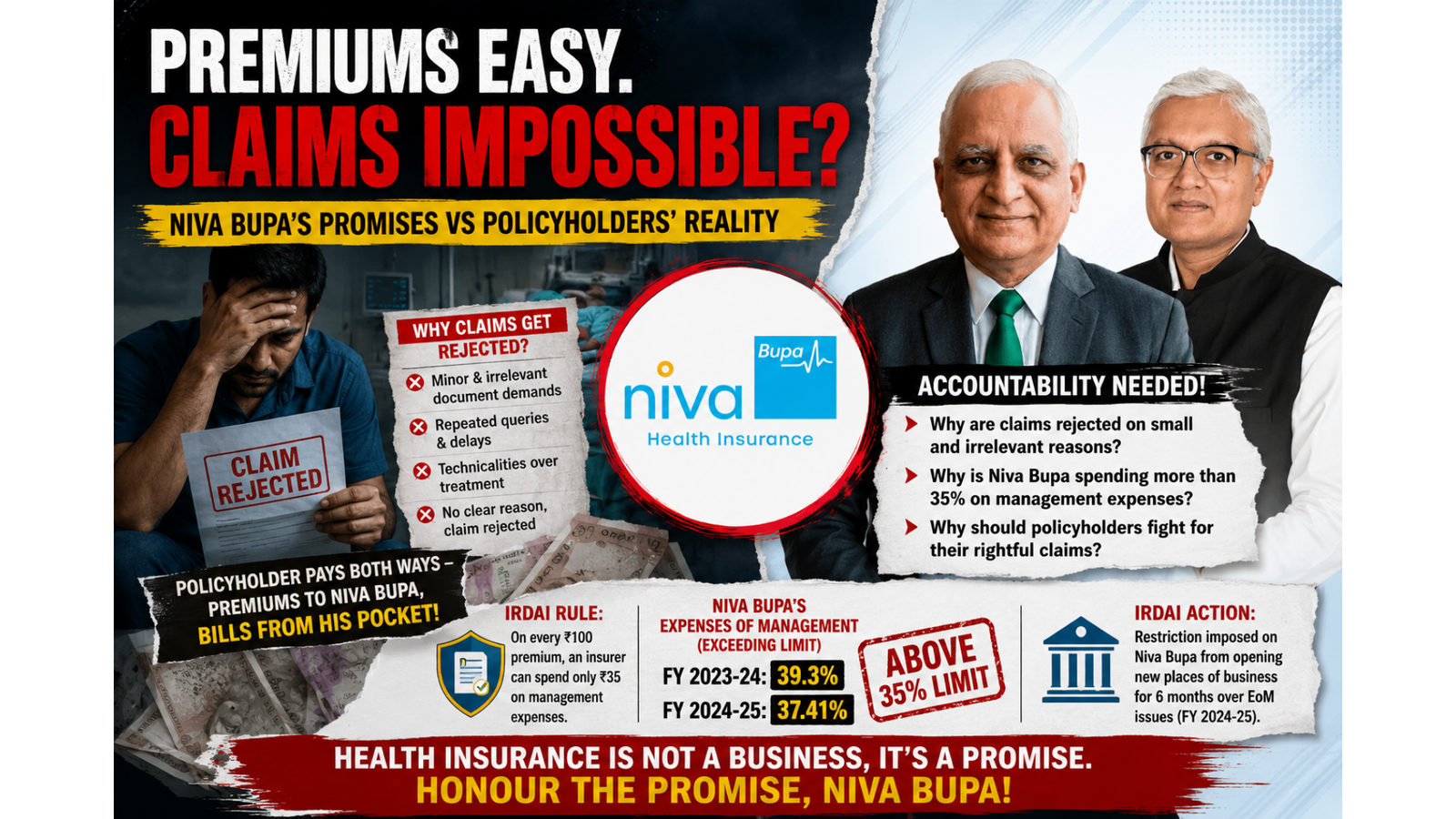


Consumers buy health insurance expecting protection in a medical emergency. But allegations of claims being questioned or rejected over seemingly minor documentation requirements, coupled with regulatory scrutiny over management expenses, raise a bigger question: when the customer needs the insurer most, how easy is it actually to get the promised cover?
SPECIAL INVESTIGATIVE REPORT
Health insurance is purchased for one primary reason — financial security during a medical emergency. A policyholder pays premiums year after year believing that when a serious illness, surgery or hospitalisation occurs, the insurer will help protect the family from a heavy financial burden. Insurance companies sell policies highlighting cashless facilities, quick processing, wide hospital networks and timely claim settlement. But the actual value of an insurance policy is not determined on the day the premium is collected. It is determined when a customer is admitted to a hospital and asks the insurer to honour the cover for which the premium has already been paid.
Questions are now being raised over the claim-handling experience of some Niva Bupa Health Insurance policyholders. Documents and claim-related communications reviewed for this report indicate disputes in which consumers have faced additional documentation requirements while seeking reimbursement or settlement. Policyholders allege that in certain instances, documents were demanded whose relevance to the actual treatment or admissibility of the claim was unclear to them. In some disputed cases, failure to provide the required information or documents allegedly became part of the reason for non-settlement or rejection. These experiences raise an important consumer question: if the treatment is genuine and otherwise covered under the policy, should a claim be rejected over a document that may have little material bearing on the treatment itself?
When Premium Collection Is Easy, Why Should Claim Settlement Be Complicated?
There is no dispute that an insurance company has the right to verify every claim before paying it. Insurers need hospital records, medical reports, bills, discharge summaries and other relevant documents to determine whether treatment is genuine and payable under the policy. Verification is also necessary to identify fraud, non-disclosure and claims falling under policy exclusions. However, consumers are entitled to know why each additional document is being demanded and how it affects the admissibility of their claim. If a claim is rejected because a particular document was not provided, the insurer should be able to clearly establish why that document was material to its decision.
This becomes especially important because a health insurance claim usually arises when a family is already under enormous pressure. A patient may be undergoing surgery or prolonged treatment while relatives are simultaneously arranging money and dealing with hospital formalities. At such a time, repeated insurance queries can add another layer of stress. If an additional document is genuinely essential, the requirement can be justified. But if a policyholder believes that a claim worth thousands or lakhs of rupees has been rejected because of a technicality with little connection to the treatment, the matter deserves closer scrutiny. Some of the documents and claim communications relating to such concerns are being presented with this report so that the basis of these questions can be examined.
Niva Bupa’s Management Expenses Also Under Scrutiny
The concerns are not restricted to individual claim disputes. Niva Bupa’s Expenses of Management, or EoM, have also attracted regulatory attention.
Under the regulatory framework of the Insurance Regulatory and Development Authority of India (IRDAI), the basic Expenses of Management limit applicable to standalone health insurers is linked to 35 per cent of Gross Written Premium, subject to prescribed allowances, adjustments and other regulatory provisions. The objective behind regulating these expenses is significant because insurers handle premium money collected from millions of policyholders.
Niva Bupa’s own FY2024-25 Annual Report reported an EoM ratio of approximately 37.41 per cent. The corresponding figure for FY2023-24 was approximately 39.3 per cent. The company has also disclosed that regulatory forbearance had been received concerning excess Expenses of Management for FY2022-23 and FY2023-24. The figures therefore raise questions that go beyond individual consumer complaints and form part of the company’s own financial and regulatory disclosures.
However, merely comparing the reported EoM percentage with the headline 35 per cent figure cannot automatically establish a regulatory violation. The IRDAI framework provides for certain additional allowances and adjustments, and compliance has to be determined after applying the complete regulatory formula. But from a consumer perspective, the figures remain significant. When a substantial proportion of premium income is being spent on management, operations, commissions and associated expenses, policyholders are justified in asking whether the claim-settlement process is receiving an equally strong focus.
IRDAI Action Put EoM Issue in Spotlight
The issue gained further significance in August 2026 when IRDAI imposed a restriction preventing Niva Bupa from opening new places of business for six months in connection with Expenses of Management-related regulatory issues concerning FY2024-25.
The regulatory action placed Niva Bupa’s management expenses under greater public scrutiny. At the same time, the company’s subsequent position must also be recorded. Niva Bupa stated that it had achieved compliance with the applicable EoM regulations for the financial year ended March 31, 2026 and for the quarter ended June 2026. The company’s later compliance position and the regulatory concerns relating to earlier periods therefore need to be viewed separately.
The development nevertheless raises an obvious question for policyholders. If an insurer is facing regulatory scrutiny over how much it spends on management and operations, what mechanisms are in place to ensure that customers seeking genuine claims are not being subjected to unnecessary procedural hurdles? For consumers, the ultimate concern is not merely how an insurance company manages its balance sheet, but how efficiently it responds when a policyholder actually needs financial assistance.
Niva Bupa Reports 92.4% Claim Settlement Ratio
There is another side of the picture that is equally important.
According to Niva Bupa’s FY2024-25 Annual Report, the company received more than 10.28 lakh claims during the financial year and reported a claim settlement ratio of approximately 92.4 per cent. This figure is significant and means that it would be incorrect to suggest, on the basis of the available company-level data, that Niva Bupa rejects most claims.
But an overall settlement ratio cannot by itself answer questions surrounding individual claim rejections. Even when a large majority of claims are settled, consumers are entitled to examine what happened in cases that were not settled. Some claims may legitimately be rejected because of exclusions, fraud, material non-disclosure or other violations of policy conditions. Others may fail because the treatment itself is not covered. The important question is whether documentation-related rejections are also being handled fairly and proportionately.
For example, how many claims are rejected primarily because a particular document was not submitted? How many initially rejected claims are subsequently approved following an internal grievance? How many are overturned after intervention by the Insurance Ombudsman or another grievance mechanism? How many policyholders ultimately abandon their claims because pursuing them becomes too complicated? Such information could provide consumers with a much clearer picture of the actual claim experience.
A Rejected Claim Is More Than Just a Number
For an insurance company, an individual rejection may represent one claim file among lakhs processed every year. For the policyholder, however, that same decision can have serious financial consequences.
A family may have paid premiums for years without making a single claim. Then suddenly a medical emergency results in a hospital bill running into several lakhs of rupees. The family approaches the insurer expecting the policy to provide the financial protection for which it was purchased. If the claim becomes trapped in repeated queries or is eventually rejected over a disputed documentation requirement, the family may have to use savings, borrow money or arrange funds from relatives to clear the hospital bill.
That is why the transparency of claim rejection is not merely a customer-service matter. It is a consumer-rights issue.
An insurer certainly cannot be expected to approve every claim presented before it. Fraudulent claims must be rejected. Policy exclusions must be enforced. Material non-disclosure cannot simply be ignored. But when an otherwise genuine claim is rejected, consumers deserve a clear explanation identifying the exact policy provision involved and explaining how the missing information or document materially affected the claim.
The Bigger Question: Does the Claim Experience Match the Sales Promise?
Health insurance companies compete aggressively for customers. Policies can be purchased online within minutes, renewal reminders are sent regularly and premium payments can be completed almost instantly. Product advertisements highlight financial security, convenience and peace of mind. Consumers therefore have every right to expect similar efficiency when money has to move in the opposite direction — from the insurer to the policyholder.
Niva Bupa’s reported 92.4 per cent claim settlement ratio deserves to be acknowledged. Its subsequent statement regarding EoM compliance also forms an important part of the story. But these figures should not prevent legitimate scrutiny of individual disputed claims, document requirements or earlier regulatory concerns.
The central issue is ultimately one of trust.
Consumers do not buy health insurance merely to receive a policy document. They purchase it because they expect their insurer to stand beside them when a medical emergency threatens their financial security. Premium collection is therefore only the beginning of the relationship between an insurer and a policyholder — not the completion of the insurer’s responsibility.
Niva Bupa should transparently address concerns surrounding disputed claim rejections, particularly cases where consumers allege that claims were affected by documents whose relevance to the treatment itself was questionable. Greater transparency on documentation-related rejection numbers, grievance reversals and Ombudsman outcomes would also allow policyholders to make more informed decisions.
Because ultimately, an insurance company is not tested when it successfully collects a premium.
It is tested when the hospital bill arrives — and the customer asks the insurer to fulfil the promise for which that premium was paid.