






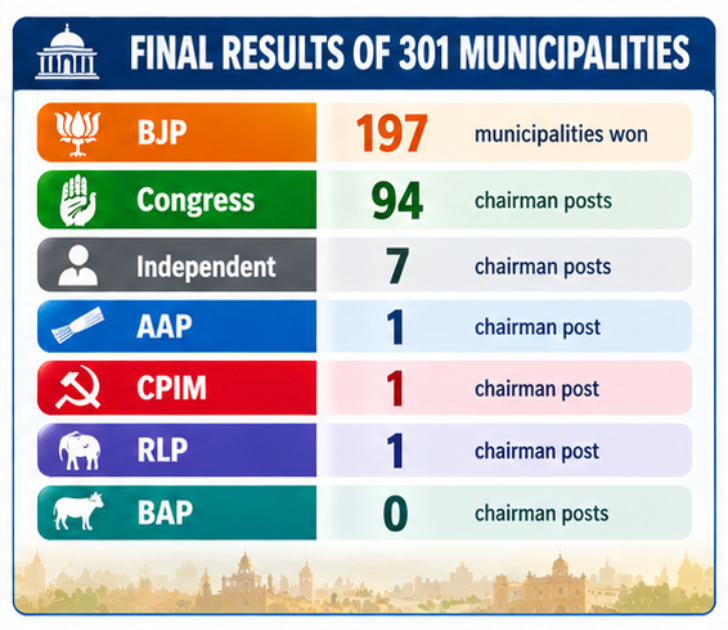
The final phase of Rajasthan’s urban local-body elections has strengthened the BJP’s position across the state, with the party securing chairperson or mayoral posts in 197 civic bodies. Congress won 94 chairperson posts, while Independents secured seven. The Aam Aadmi Party, CPI(M) and Rashtriya Loktantrik Party won one chairperson post each.
The outcome underlines the importance of post-poll alliances, cross-voting and Independent councillors in Rajasthan’s urban politics. While the BJP maintained only a narrow lead over Congress in the overall vote share, it converted its performance more effectively into ward victories and control of civic bodies.
BJP Wins Six Mayoral Posts
The BJP won six of the seven mayoral contests decided on Monday, while Congress secured the Bikaner mayor’s post.
In Udaipur, BJP candidate Paras Singhvi was elected mayor. In Alwar, BJP’s Suman Lata Agarwal won the mayoral election. BJP candidates also captured the mayoral posts in Ajmer and Pali, where Anamika Sharma and Namita Bubakia were elected respectively.
In Bhilwara, BJP’s Jaswant Kanwar was elected unopposed as mayor. Anuradha Singh was also elected unopposed in Bharatpur. Congress’s Anil Kalla won the mayoral post in Bikaner.
The mayoral elections in Jaipur, Jodhpur and Kota are scheduled for September 25.
Ajmer and Pali Turnaround
Ajmer and Pali emerged as the most significant examples of how the mayoral election results can differ from the ward-election outcome.
In Ajmer, Congress had emerged as the single-largest party with 37 councillors in the 80-member corporation, compared with BJP’s 32. However, BJP candidate Anamika Sharma secured 43 votes in the mayoral election, while Congress candidate Kiran Garhwal received 37 votes.
The result indicated that BJP received the support of all 11 Independent councillors. Congress received votes equal to its own councillor strength, despite being the largest party in the ward election.
In Pali, Congress had won 29 wards, BJP 21 and Independents 15 in the 65-member municipal corporation. However, BJP candidate Namita Bubakia secured 33 votes and was elected mayor.
Independent candidate Rajbala Hingad received 29 votes, while official Congress nominee Sumitra Jain secured only three votes. The voting pattern indicated a major split within the Congress camp, while the BJP reached the majority mark with support from Independent councillors.
Close Vote Share, Wider Outcome
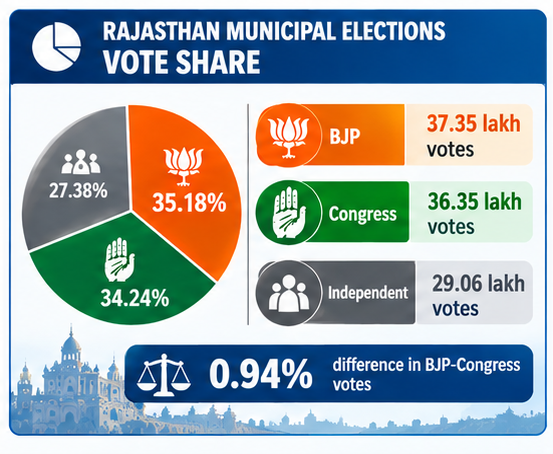
The final vote-share numbers showed that the BJP and Congress were separated by less than one percentage point across Rajasthan’s urban local-body elections.
The BJP secured 37.35 lakh votes, accounting for 35.18 percent of the total votes polled. Congress received 36.35 lakh votes, or 34.24 percent. The difference between the two parties was 99,615 votes, or 0.94 percentage points.
Independents received 29.06 lakh votes, representing 27.38 percent of the total votes. Their large vote share highlighted their continuing influence in Rajasthan’s local politics.
The BJP’s strong performance has been linked to its organisational presence in small towns, its hold in tribal areas and its ability to secure support from Independent councillors after the ward results.
The party also campaigned on issues including employment, recruitment examinations, prevention of paper leaks and governance. In some major cities, political observers also noted the impact of protests and debate surrounding higher education and University Grants Commission-related issues.
For Congress, the results have raised questions about collective leadership, campaign coordination and internal unity. The party’s inability to prevent rebel candidates from entering the contest and to secure Independent support in key civic bodies proved costly.
The elections produced a close popular vote but a clearer advantage for the BJP in the final political outcome. With mayoral elections in Jaipur, Jodhpur and Kota still pending, the contest for control of Rajasthan’s urban bodies is not yet complete.