




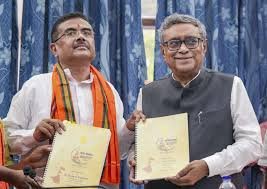


West Bengal first full-fledged Budget for the financial year 2026-27 signals a significant change in the state’s development strategy. Presented by Finance Minister Swapan Dasgupta, the Budget proposes a total expenditure of ₹4,38,775.29 crore, with a strong focus on infrastructure, industrial growth and employment generation while continuing existing welfare schemes.
For years, West Bengal’s economy has largely been identified with social welfare programmes and direct cash assistance. While the new government has assured that these benefits will continue, this Budget suggests a broader vision aimed at transforming the state into a major economic and industrial hub in eastern India.
Shift From Welfare to Infrastructure
One of the biggest takeaways from the Budget is the government’s emphasis on capital investment. Rather than relying solely on welfare spending, the administration is now looking to create long-term economic growth through better infrastructure and improved connectivity. Officials say the strategy is aligned with the Centre’s vision of “Viksit Bharat”, with the goal of making West Bengal a key destination for trade, logistics, manufacturing and technology.
Mega Deep-Sea Port Takes Centre Stage
Among the most ambitious announcements is the proposal to develop a deep-sea port at Dadanpatrabarh in Purba Medinipur district. The project is expected to be executed under the Public-Private Partnership (PPP) model and is designed to accommodate some of the world’s largest cargo vessels. Once completed, the port could significantly strengthen Bengal’s maritime trade network and improve cargo movement across eastern India.
The government believes the project could attract substantial private investment while generating employment opportunities in logistics, shipping and allied industries.
Airports and Better Connectivity
The Budget also places major emphasis on improving air connectivity. The government has identified 1,000 to 1,500 acres of land near Kalyani for a proposed greenfield airport, which is expected to ease pressure on Kolkata’s Netaji Subhas Chandra Bose International Airport.
In addition, regional airports at Malda, Purulia and Balurghat are set to be developed under the Centre’s UDAN regional connectivity scheme, improving access to smaller towns and encouraging tourism and business activity.
Industry-Friendly Reforms Announced
To attract investors, the government has announced a ₹5,000 crore investment promotion fund aimed at supporting industrial expansion. A major reform proposed in the Budget is the introduction of a mandatory single-window clearance system for all industrial and corporate projects worth more than ₹100 crore. The move is intended to reduce bureaucratic delays that have often discouraged investors.
The government also plans to review the existing Urban Land Ceiling policy, with the objective of making larger land parcels available for industries, manufacturing units and technology parks. Among the key proposals is the development of a dedicated IT hub in Siliguri, which could help expand Bengal’s technology sector beyond Kolkata.
Funding the Growth Plan
The ambitious Budget represents an 8.3% increase over the previous interim Budget. According to the government, a large portion of the increased spending will be supported by higher central grants, which account for more than 73% of the additional fiscal capacity. The state is also expecting around 37% growth in its own tax revenue, helping finance its development plans.
Focus on Sustainable Development
Another notable feature of the Budget is its commitment to sustainability. Nearly 69% of total Budget allocations have reportedly been linked to the United Nations Sustainable Development Goals (SDGs). The government plans to invest in green energy, climate-resilient infrastructure and environmental protection, particularly in the ecologically sensitive Sundarbans region.
While the success of these proposals will ultimately depend on timely implementation and investor participation, the 2026-27 Budget clearly indicates that West Bengal is attempting to move beyond a welfare-driven economy and position itself as a competitive destination for infrastructure, industry and technology-led growth.