






With the first round of group-stage fixtures now complete, the FIFA World Cup 2026 standings are beginning to take shape across all 12 groups. Several title contenders made strong starts with convincing victories, while a few underdogs produced eye-catching results that have already shaken up their groups. That being said, there is still plenty of football left to be played, and every point could prove crucial in the battle for qualification to the knockout rounds following Matchday 1.
Traditional Powers Dominate Early Rounds
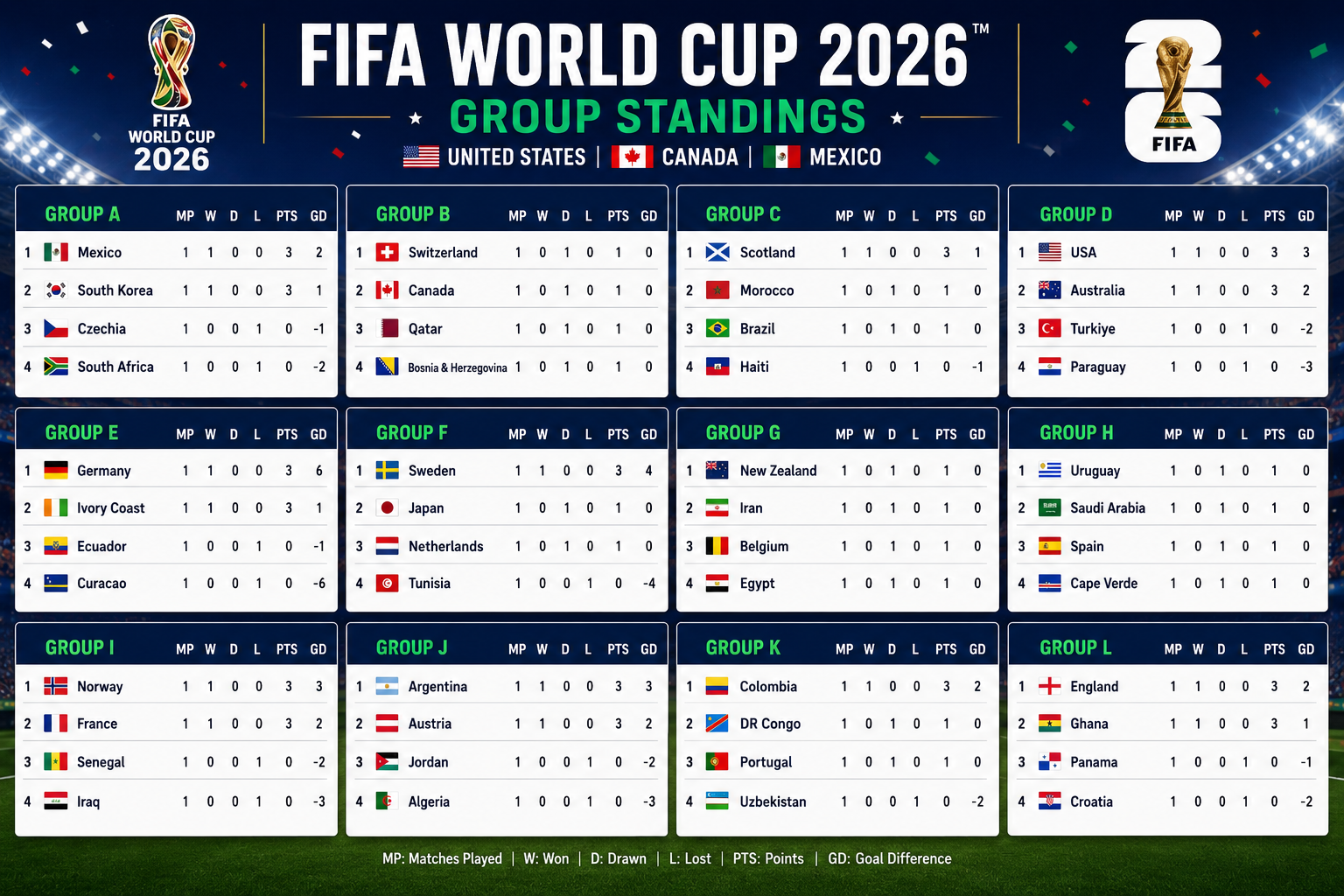
The heavyweight teams sent clear messages of their tournament ambitions with dominant opening performances. Germany delivered the most striking display, crushing their opponents with a remarkable 6-goal game difference to top Group E with 3 points. Meanwhile, USAshowcased their home advantage potential with a 3-goal GD victory in Group D, matching Australia who also secured 3 points despite Turkiye and Paraguay’s presence.
In Group I, both Norway and France won their opening matches, with Norway leading on GD (3) over France (2). Argentina continued their World Cup dominance in Group J with a 3-goal GD win alongside Austria, while England and Ghana both secured victories in Group L, setting up an intriguing battle for top spot. Mexico and South Korea shared Group A’s top positions with 3 points each, distinguishing themselves from Czechia and South Africa who sit at zero.
Shock Results and Tight Groups
Some groups remain completely unsettled after Matchday 1, creating genuine uncertainty about knockout destinations. Group B stands out as the most dramatic, with all four teams—Switzerland, Canada, Qatar, and Bosnia & Herzegovina—locked at exactly 1 point each with identical 0 GD, making every remaining match pivotal.
Similarly, Group G features New Zealand, Iran, Belgium, and Egypt all sharing 1 point and 0 GD, while Group H presents an identical scenario with Uruguay, Saudi Arabia, Spain, and Cape Verde equally positioned at 1 point. These four-way ties mean the next two matches in each group will determine which teams advance.
Scotland emerged as an unexpected leader in Group C with 3 points and 1 GD, sitting ahead of Morocco and Brazil who both drew their opening matches. Sweden dominated Group F with a 4-goal GD victory, leading Japan and Netherlands who drew, while Tunisia sits at zero.
Underdogs and Unexpected Winners
Some lesser-known teams have made impressive statements. Ivory Coast matched Germany’s 3-point start in Group E with a 1-goal GD win, proving they can compete with traditional powers. Colombia leads Group K with 3 points and 2 GD, while DR Congo and Portugal both hold 1 point from draws.
Knockout Qualification Rules Intensify Competition
The qualification framework adds extraordinary pressure to every match. As has been standard across FIFA World Cups, the top two teams from each group will progress to the knockouts. However, since this edition features 48 teams, the eight best third-placed teams will also move to the next round, meaning even teams finishing third can still advance if their point total and GD compare favorably against other third-place finishers.
This expanded format means groups with multiple 1-point teams like B, G, and H could see dramatic final-day scenarios where even a draw might not guarantee advancement. Teams must now maximize every point, as the difference between qualifying and elimination could be a single goal or a single point.
With 11 more matchdays remaining across all groups, the competition for knockout slots has already intensified, and every team knows that dropped points in the early rounds could prove fatal to their World Cup dreams.