




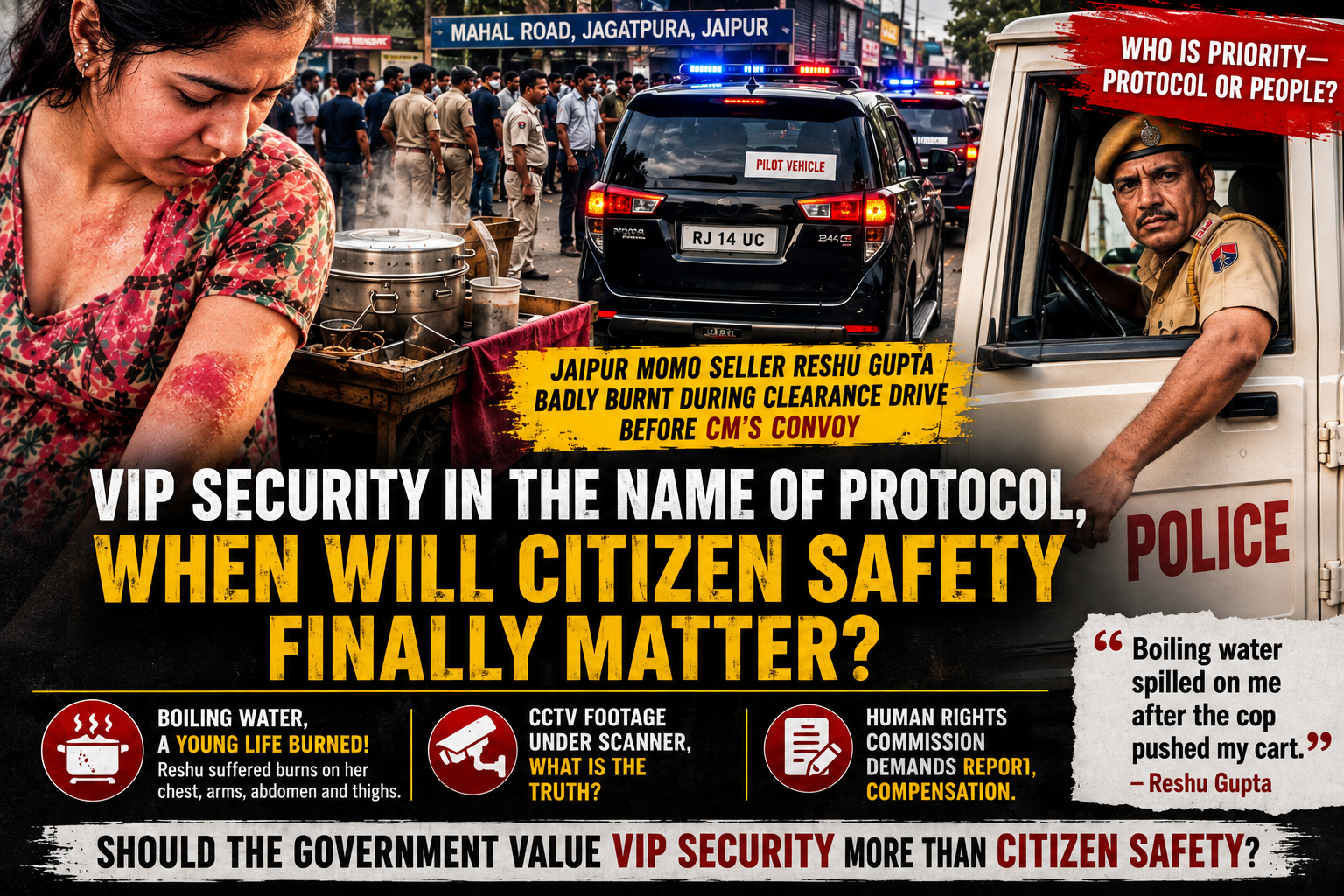


A disturbing incident in Jaipur has once again raised questions about the protocol for VIP movement, the conduct of the police, and the priorities of the state government in Rajasthan. Public outrage has erupted as young momo seller Reshu Gupta got badly burnt during a roadside clearance drive before CM Bhajanlal Sharma’s convoy in the Jagatpura area, raising sharp questions about whether administration values VIP security more than citizen safety.
According to the complaint and the victim’s version published by The Indian Express and other media outlets, police personnel were removing roadside carts near Mahal Road in the evening of June 19 when an argument broke out between officers and the vendor. Reshu alleged a policeman pushed her cart, and the boiling water kept in a steamer spilt on her chest, arms, abdomen and thighs despite her having been warned about it. The police, however, stated that they were investigating the matter and reviewing the CCTV footage.
The incident has posed uncomfortable questions before the Bhajanlal Sharma government. Why should roadside vendors be cleared in this manner minutes before the convoy of the chief minister was to pass? Why were there allegedly inadequate warnings, a safer relocation plan, and on-ground arrangements to protect citizens whose livelihoods are often the first to be disrupted during VIP movement?
The Rajasthan State Human Rights Commission has already sought a report from the Jaipur Police Commissioner, the District Collector, and the Deputy Commissioner of Police (East) on whether any public servants have been held guilty and what legal action has been taken. It also directed the government to provide appropriate medical treatment and compensation to the victim and highlighted the gravity of the allegations.
This is not an isolated incident of outrage. In Rajasthan, there have been repeated instances of conflict between encroachment drives, road-clearance operations and street vendors’ livelihoods, although the exact consolidated state-level figures on such burn-injury incidents are not available in the cited reports. In the current case, though, it fits a wider pattern in which poorly thought-out, heavy-handed or uncommunicative measures can turn a routine security exercise into a public relations disaster for the government.
The bigger issue is as much political as administrative. If the VIP movement routinely inflicts fear, injury, or humiliation on ordinary people in Rajasthan, then the government must explain why security planning continues to seem so insensitive. We cannot allow the police to hide behind protocol when a citizen alleges injury and trauma, and the state cannot treat such episodes as minor collateral damage.
The message to Bhajanlal Sharma and the BJP government is clear: VIP security should not be a cover for avoidable excesses. The administration now faces a test of credibility to determine whether it will see that there is accountability, compensation, and reform—or let the matter drift into another unresolved outrage.