




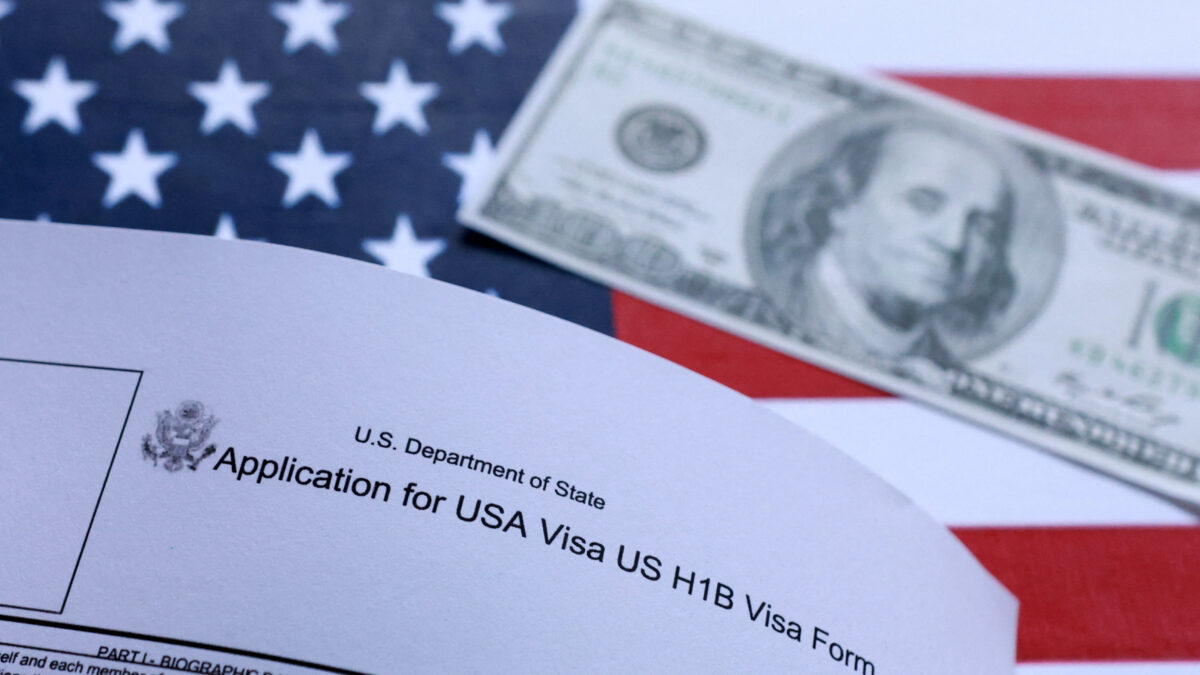


In another setback to U.S President Donald Trump’s anti-immigration policies, U.S District Judge Leo Sorokin in Boston struck down his move to impose a $100,000 fee on new H-1B visas for highly skilled foreign workers. News agency Reuters reported that Sorokin said the fee was an unlawful tax that the Congress had never authorised.
The ruling came after a lawsuit filed by 20 Democratic state attorneys general challenging the move, which was announced in September.
The Trump administration’s proclamation to impose the $100,000 fee had said that the H-1B programme “has been deliberately exploited to replace, rather than supplement, American workers with lower-paid, lower-skilled labor,” which has subsequently “undermined both our economic and national security”.
The proclamation further added, “Some employers, using practices now widely adopted by entire sectors, have abused the H-1B statute and its regulations to artificially suppress wages, resulting in a disadvantageous labor market for American citizens, while at the same time making it more difficult to attract and retain the highest skilled subset of temporary workers, with the largest impact seen in critical science, technology, engineering, and math (STEM) fields.”
Currently, the H-1B programme offers 65,000 visas annually, with an additional 20,000 visas for workers with advanced degrees, approved for three to six years. Employers looking to obtain a visa for a foreign worker had to pay a fee of around $2,000 to $5,000.
Due to the increase in fees, requests for H-1b visas had gone down, with the US Citizenship and Immigration Services receiving only 85 payments as of February 15, according to the administration’s statement in March.
The Trump administration argued that the fee was a monetary penalty the President had lawful authority to impose under federal immigration law to restrict the entry of foreing nationals. However, the court dismissed the argument.
“The President has no authority to levy a tax unless such a power is delegated by Congress through statute… the Court finds that the Policy imposes a tax on H-1B petitions without the requisite delegation by Congress. (hence) the Policy implementing the Proclamation is declared unlawful and is vacated in its entirety,” said the ruling.